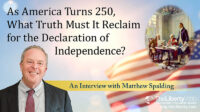
As America Turns 250, What Truth Must It Reclaim for the Declaration of Independence?
An Interview with Matthew Spalding
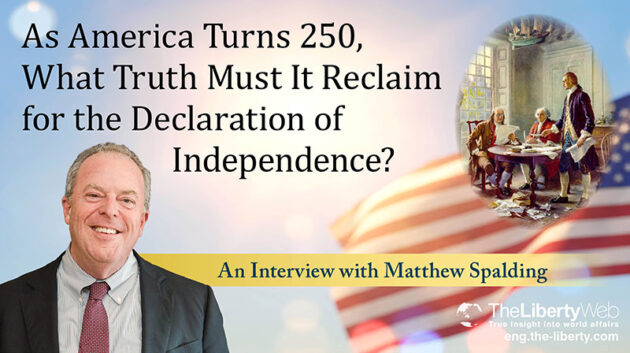
The Declaration of Independence reflects the Founding Fathers’ cosmological and spiritual worldview. As Lincoln observed, it was destined to serve as a “beacon” for generations to come. The Liberty spoke with Dr. Matthew Spalding to explore its enduring significance.
(Interviewed by Satoshi Nishihata
Planned & Edited by Hanako Cho)
Dr. Matthew Spalding
Matthew Spalding holds a bachelor’s degree from Claremont McKenna College and master’s and doctoral degrees in government from the Claremont Graduate School. He serves as the Kirby Professor in Constitutional Government and Dean of the Van Andel Graduate School of Government at Hillsdale College, and oversees the Allan P. Kirby, Jr. Center for Constitutional Studies and Citizenship at Hillsdale’s Washington, D.C. campus. His latest book, The Making of the American Mind: The Story of Our Declaration of Independence, was released in December 2025. Appointed executive director of the President’s Advisory 1776 Commission, which produced The 1776 Report, he is currently a senior academic advisor for America250 projects.
What Motivated You to Write This Book
──Could you briefly tell us what motivated you to write this book?
A couple of things. One is the practical motivation, which is that I knew that the United States was going into this important anniversary, the 250th anniversary of the beginning of the American Revolution, the Declaration of Independence. So I wanted to have a book out at this moment. I wrote it, and it came out right at the end of 2025, so it would be influential in 2026.
And then, I would probably say the broader reason I wanted to write this book is that I think a lot of the ideas of the Founding, and the Declaration in particular, have been neglected, and some of them misunderstood, and that’s a problem. I actually think that a lot of the contemporary debates about American politics, international politics, socialism, Marxism, communism, all these modernisms, forms of modern liberalism, could be commented on, if not answered, by a better understanding of the principles of the American Founders. Because these principles were so philosophically grounded and robust, I think it’s important to recover them.
──You wrote in this book that Thomas Jefferson essentially articulated the common sense of that time. Why do you think the Founding Fathers were able to develop such a sense of freedom?
Jefferson articulated it clearly. He says in a letter he writes to Henry Lee that he wanted the document to be an expression of the American mind, which is where I get my book title from. He was trying to capture something that was already there. The American electorate in 1776 was very well-read and very knowledgeable. Much of the debate was being argued in pamphlet form, so there was a very robust conversation going on about these ideas.
The people in the Thirteen Colonies studied history, which meant British history. They read the classics and studied Cicero because they were interested in law. And the horizon of the culture was really Christianity. They took all these things seriously. I would also add the historical circumstances: the various colonies were established by different groups of people coming over at different times, essentially seeking freedom—in particular, religious liberty in many cases—but also the liberty of building opportunity, economic and otherwise. There was a strong sense of wanting to be free and to self-govern. The colonists had the habit of self-governing from the end of the French and Indian War in 1763 up until the 1770s. Americans were learning to govern themselves when the British started taking that away. Jefferson was trying to capture all of that in the Declaration of Independence.
──While Jefferson was hugely influenced by John Locke, you made the important point that the Declaration was not influenced by Locke’s view of human nature. In chapter two, you trace the origins of natural rights back to the tradition of natural law beginning with Plato and Aristotle, and the dual tradition of the divine law of nature and Scottish common sense philosophy. How did you arrive at this insight, and why is it important?
Well, first of all, it’s a great question. America is often criticized on both the Left and the Right for being overly Lockean, and I wanted to get at exactly what that meant. My main teacher was a student of Leo Strauss, a great political thinker and philosopher. Strauss criticized Locke for being more Hobbesian intellectually. But that left open the question: what is the practical answer? What actually influenced the Declaration? My teacher, Harry Jaffa, went into that deeply and pointed me in this direction.
The question of what exactly Locke’s political philosophy is, that’s one question. But that’s not the most important question. The important question is: what did the Americans think? Because they weren’t political philosophers or academic Straussian political thinkers. They were statesmen, practical political thinkers building a nation. When you go down that path, things look very different. They studied the political Locke, but there is very little evidence, if any, that the philosophical Locke, where the problems start occurring, influenced them at all. So the question becomes: if they read the political Locke, how did they understand him? And that’s where the natural law tradition becomes most important. It looks to me like they read Locke through that tradition. And that’s what we should study to understand America.
The ‘Theology’ of the Declaration of Independence
──You argue that the Declaration of Independence is not merely a political document, but also a powerful theological document. Could you elaborate on this view?
It is important to understand that the Founders, in particular the colonists coming over to North America, were seeking, among other things, religious liberty. They wanted to avoid the civil wars that tore apart Europe: the Catholic and Protestant wars in England, the inter-Protestant conflicts that led to death and persecution. They didn’t want that. So instead, they chose general terms throughout the document.
For instance, they use the word ‘Creator.’ There’s also a reference to the ‘Supreme Judge of the world,’ who judges the rectitude of our intentions. And the last reference is to ‘divine Providence.’ These are not empty phrases. They’re actually meaningful. There’s a strong theology to them, a sense of God in the Declaration. That God intervenes, which is what divine Providence implies. This is a God that sometimes intervenes providentially, who pushes things in a direction. George Washington believed strongly that Providence played a role in the American Revolution. So, in that sense, it is not merely a secular, rational document, as some criticize it to be. There is a theology to it, much more substantive, even if not specific. There is something there that is very important. You can’t really read the Declaration without it.
Why ‘Creator’ Was Embedded in the Declaration
──The word ‘Creator,’ which was not present in Jefferson’s initial draft of the Declaration of Independence, was later inserted. Could you explain the circumstances leading to this change and the significance of the document’s assertion that the rights to life, liberty and the pursuit of happiness are endowed by the Creator?
This is very important. The first reference to God in the Declaration is actually in the first paragraph, which refers to ‘the laws of Nature and of Nature’s God,’ broadly speaking, a reference to natural law and what is called general revelation. That is, what you can understand through your own reason about the created order around us.
The particular phrase you’re talking about is in the second paragraph, and it is actually twofold. Jefferson does say these truths are self-evident. The first one is: ‘All men are created equal.’ So the word ‘created’ had already been introduced. What gets added is that all men are created and they are endowed ‘certain unalienable rights’ by their Creator, a repetition of the word. It’s like underlining it. They underscore this sense of the Creator. I think it is extremely important.
The insertion of that second reference tells us that not only is there the laws of nature and of nature’s God — very general, universal order — but that God created man in particular. All men are created equal. And men are endowed, meaning they are actually given certain rights. It’s a step-by-step process by which the role of God becomes more and more important, because it then turns out that life, liberty, and the pursuit of happiness are endowed into man.
The Purpose of Politics Is the Realization of Happiness
──The concept of ‘property,’ found in Locke’s Two Treatises of Government, has been replaced by ‘the pursuit of happiness’ in the Declaration of Independence. You also say that the meaning of this happiness is rooted in a very noble view of humanity and is a concept imbued with virtue. Could you elaborate on the meaning of the word ‘happiness’?
First of all, you are correct to bring this up. The Lockean phrasing is ‘life, liberty, and property.’ In no draft, at no time, is ‘life, liberty, and property’ used. It’s always ‘life, liberty, and the pursuit of happiness.’ That’s important.
The word ‘happiness,’ however, is impossible to use without understanding its broader meaning. The signers of the Declaration were all educated people, a well-read group who knew their history. And the word ‘happiness’ in Greek philosophy, Roman political thinking, and the whole Christian tradition means ‘the end of politics.’ Happiness is the end of the good of man in particular, and of the good of politics. And happiness in all those traditions—the Greeks, the Romans, and the Judeo-Christian tradition—meant substantive happiness. True and substantive happiness. Not what makes you feel good, not whatever you want to do, but what constitutes human flourishing. That’s where you get this larger sense of what is the good of man. I think the use of the word happiness in the Declaration is both significant and substantive.
Freedom as a Created Being
──In your book, you argue that America’s true greatness lies in the Declaration of Independence. What do you think God entrusted to America through the Declaration of Independence?
I do believe that America’s true greatness lies in the Declaration of Independence, for all the reasons we’re discussing here. But it’s also a condensation of the most important ideas that influenced the whole Revolution. I actually do believe there’s a certain providential role that America plays in the history of Western Civilization. It’s hard to read that history without potentially seeing that. Of course, it is not crystal clear. But there’s something there.
The Declaration is not composed of completely new, crazy ideas that Jefferson made up. He’s capturing the American mind of 1776, but this American mind is grounded in a long-standing tradition dating back thousands of years to early Christianity and Greco-Roman antiquity. The Declaration is just the best expression of those ideas. What we mean by natural law is what man can see through his reason, which includes a general concept of God, of the Divine. So, I do think there’s a providential aspect of God entrusting to America this flame of liberty. But I also think that in the Declaration, there’s a recognition that man, metaphysically, in his mind, can actually grasp something about the Divine, and that is not specifically or uniquely American. Anybody else in any other country in the world can also grasp that as well.
What I do know is that the Declaration says: if you are true to yourself, meaning true to your human nature, which is created by God, there are certain things you should grasp. If you believe that God created man and endowed him with these liberties and these rights, the expectation is that man ought to uphold those liberties and rights in order to flourish as a human being. The Declaration is the engine for understanding liberty in its truest sense. And that liberty then allows for religious liberty and the flourishing of moral communities, but also entrepreneurship, markets, exploration, invention — all of those things. But that comes from this general sense of equal rights, freedom, and self-government.
──Does this mean American exceptionalism originates here in the Declaration?
The argument of American exceptionalism is that America is exceptional because it is a particular country, the United States of America, but this particular country is dedicated to recognizing and upholding these universal truths named in the Declaration. When the Declaration says ‘all men are created equal,’ it doesn’t just mean all Americans are created equal. It means all Japanese are created equal too. What is exceptional about America is that this particular country enshrines those universal principles in our founding document. We didn’t invent these ideas, but we introduced the notion that you could have a particular nation dedicated to them.
Government Is Merely a Means to Secure the Freedoms Entrusted by the Creator
──President Trump often says that freedom comes from God, not from the government. Do you have any comments on this?
One of the things made very clear by the American Founding, and the Declaration in particular, is that our rights as human beings do not come from government. That is crystal clear. The Declaration tells us that we are created equal and endowed by our Creator with these rights. So there’s a very strong argument that they come from God. I don’t dispute or doubt that.
But you should also keep in mind that the Declaration grounds these rights in the ‘laws of Nature and of Nature’s God,’ which means there’s something we can come to understand ourselves through our reason as well. The general answer is that these rights are clearly not from government. They are from our nature as human beings. You can understand that nature as having been created by God, but you can also understand it, in the sense of Aristotle or Cicero, as simply something we can observe or come to grasp through our own reason.
That is an important aspect because even those who don’t believe in God or aren’t specifically religious should still agree that rights do not come from government. If rights came from government, that would imply that government makes up rights and can take them away. But no, these rights are inalienable. They are in our very nature, in our very being. The Declaration of Independence makes clear that government is merely a means to secure these natural rights.
Why the Average Citizen, Not the Elite, Is Capable of Self-Government
──People on the left appear to believe that reason, in the ancient Greek sense, the ability to judge right from wrong, exists only in a few people, and that only the government can determine what constitutes a better life. Consequently, they view the general public as ignorant and reliant on the government. This approach counters the principles of the Declaration of Independence which states that every individual can pursue a virtuous and happy life. Where does their misunderstanding stem from?
I would reframe the question and put it this way. It’s not that people on the Left appear to believe that reason exists in only a few people. It’s that the Left — if you think of modern liberalism, postmodernism, and also concepts like socialism, communism, Marxism — they don’t believe in reason. The sense of reason you see in the Declaration, going back through the tradition to the Greeks, to reason or ‘logos;’ they gave up on that a long time ago. Instead, reason is replaced by something else. In Marxism, it would be the rule of the proletariat, or the vanguard of the party. These other replacements for reason oftentimes use the state to enforce their right to rule.
That is a deep misunderstanding not only of the Declaration, but also of reason itself. Because reason implies self-government. That is, man has enough ability to choose and choose well, to think and deliberate, that he can rule himself. He can self-govern, which means he can also collectively make laws and give his consent to abide by the rule of law. All these modern concepts reject that.
Modern liberalism in America doesn’t think that man in general has reason in the way the Declaration does. They think man is ruled by his opinions and passions. In their case, it’s always someone else who should rule: the really smart people, the academics, the Ivy League professors, the administrative state experts. The elites should rule. The radical claim of the American Revolution is: no, the average American can govern themselves. This is why civic education is important.
Presidents Guided by Divine Providence: George Washington and Donald Trump Survived Assassination Attempts
──George Washington survived assassination attempts during the war. President Trump similarly survived three assassination attempts and sees divine Providence in his survival, often saying, ‘This is only by the grace of Almighty God.’ What are your thoughts? And what would have happened if Washington had been killed at America’s founding?
This points to the importance of individual character. I don’t think the American Revolution would have been successful had Washington not been the Commander of the Continental Army. There was something special about him. He understood the principles for which they were fighting for deeply, but he also had a certain moderation and strength of character that was important. And, as you point out in your question, he had a sense of divine Providence. The British attempted to assassinate him during the war, but were not successful.
Lincoln, too. Throughout the Civil War, when attempts were made against him, he always thought his survival was providential. A more modern example would be Ronald Reagan, who, in his memoirs, credited God for his survival after he was shot. He lived in order to bring an end to the Cold War.
So how individuals understand their own role relative to a providential God in human affairs is very important.
America Fighting for the Realization of Freedom
──According to a Harvard poll, over 70% of those who supported the Trump administration also endorsed its policy toward Iran. This shows the public is seeking justice. Can you explain the role that the Declaration of Independence plays in fostering sensible citizens?
What is especially interesting and unique about America is the extent to which it deeply combines two things. One is a very practical concern that all nations focus on: their own interest, survival, and defense. But America is also dedicated to this higher idea of permanent principles: self-government, human liberty, a recognition of equal humanity, what you call here, justice.
In the case of Iran, there was a threat to us in particular, so we were acting in self-defense. But it’s also an existential threat to many other nations, for which we then stepped in to protect them. And in doing so, we are defending what we might broadly call Western Civilization. So there’s always this way in which our particular interest and our particular understanding as a nation is tied to these larger principles.
These principles inspire others around the world, which is why so many people immigrate to America for a better life. The other great example I always think about in this context is the Cold War. People who were imprisoned in the Soviet Union, who wrote memoirs, they heard Reagan’s words, what he talked about, what he said. And they were looking to America to understand what a government that protects these higher principles of human liberty looks like in practice. That’s no coincidence.