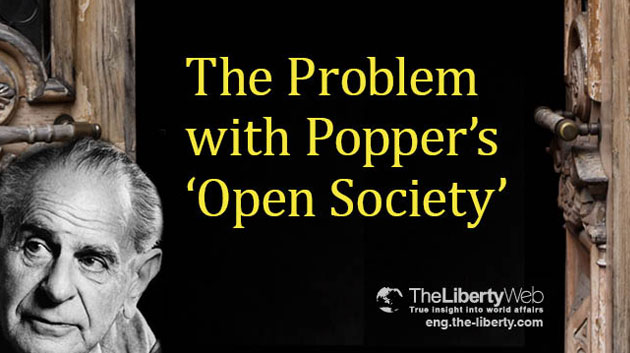
The Problem with Popper’s ‘Open Society’ (Part 1)
Karl Popper’s philosophy quietly exerts its influence on modern society, even today. Did he make any mistakes in his beliefs?
(Hanako Cho)
Master Ryuho Okawa, the CEO and founder of Happy Science, has preached in his psalm “Open Society” (*1) as follows:
Modern intellectuals seem to regard the philosopher Plato, who taught about souls and the Spirit World, as nothing but a tyrant who tried to lock humans in a world of superstitions.
They also seem to regard the philosopher Hegel, who like Plato, tried to establish philosophical ideas that led to God as a totalitarianism.
They then say that Hitler of Germany, misled by the ideas of Plato and Hegel, advocated totalitarian fascism and rampaged toward destruction…
That is why those intellectuals in such a foolish democratic society, think that there is no need for God, no need for the Spirit World, and no such thing as spirits or souls.
I, myself, teach that this third dimensional world is structured like an egg, encapsulated by the higher realms of the fourth dimension and above.
I am teaching such a world as a true “open society,” but many scholars see it as a “closed society.”
Popper Did Not Experience the Spirit World
“Open Society” was a term coined by 20th century philosopher Karl Popper in his book, “The Open Society and Its Enemies.” Popper claimed that the empirical and rational, scientific world is the “open society”—meanwhile, discussing reincarnation and the spiritual world would set people back to the ignorant and unenlightened “closed society.”
Plato discusses the idea of reincarnation in his works, including “The Republic,” “Gorgias,” and “Phaedo.” He depicts the tragedy of a soul that chooses the life of a dictator, and emphasizes God, the existence of the spiritual world, and the importance of self-help and effort that takes you closer to God. However, Popper dismissed this all as “The Spell of Plato.” Rather, a rational society is the true “open society,” Popper claimed.
Plato believed that this three-dimensional world was a space for Ideas, or Forms, to be projected onto. In other words, he regarded everything in this world as fiction and sought to realize the True Reality that existed in the other world. At the time, materialists such as Democritus hypothesized that this entire world was made up of physical matter, so Plato’s theory of Ideas was a fundamental counterargument to them.
This theory of Ideas relates to our soul’s memory. The existence of Ideas equates to our souls existing before our birth. This serves as evidence to the theory that souls never perish.
Master Ryuho Okawa has stated that Plato produced intellectual explanations of the Truth, foreseeing the rise of a Western civilization that would be based on the intellect (*2). Plato built up layers of earthly logic before ultimately arguing for the existence of another world.
Despite that, Plato’s writings have been difficult to understand, not just by Popper, but other modern philosophers as well. Why is that?
This is because “he experienced astral travel while living in this world and made numerous trips to the heavenly realm.”
Plato’s philosophy stands on the opposite of Popper’s, who constructed his philosophy solely through knowledge and experience in this world.
Plato advocated for happiness that carries through this world and the next after having experienced the worlds beyond the third dimension. He liberated human beings to an “open society” by liberating them to the fourth dimension and beyond.
The Poison That Continues to Spread
It was inevitable that an immoral and self-serving strain of liberalism would emerge as a wayward offspring of Popper’s philosophy, which emphasizes freedom from something.
A prime example is George Soros, an investor who looks up to Popper as his mentor. Soros established the Open Society Foundations, which works to advance atheistic, far-left liberal activities on a global scale. As Tyler O’Neil, an editor of the Daily Signal who has followed this topic closely, has noted, it was Soros’ foundation that sought, through the U.S. Agency for International Development (USAID), to promote transgender ideology and diversity, equity, and inclusion (DEI) (*3) initiatives worldwide, all under the name of diversity.
Popper’s influence on academia has also been considerable. The late Junichi Aomi, a former professor at the University of Tokyo’s Faculty of Law, was a devoted admirer of Popper. Master Ryuho Okawa, who attended Professor Aomi’s lectures at the time, later reflected on his experience:
“[Aomi] regarded philosophers who were aware of the existence of the Spirit World as ancient shamans while he viewed scholars who confined their research solely to this physical world as guides to an ‘open society.’ When I clairvoyantly observed Professor Aomi, I could see not a halo behind his head, but a dark cloud—a troubled, resentful spirit clinging onto him. Unfortunately, Ryuji subjected him to thorough and unsparing criticism” (*4).
Master Ryuho Okawa wrote at the end of his exam, “You must fear for your afterlife.”—it was a warning. True to those words, Dr. Aomi said in a spiritual reading that “he has been in pitch-black darkness” since his death (*5).
As a university student, Master Okawa had a piercing insight that “if philosophy of law leads one to the deepest part of hell (Avīci), then positive law itself is in danger. Education is leading humanity toward a world without salvation” (*4).
The importance of natural law has revived since the emergence of Nazi Germany. Natural law questions the validity of human-made laws at a fundamental level. It was precisely when the positive laws enacted by the Nazi regime were deemed legitimate “law” that humanity was led into the tragedy of the mass slaughter of the Jewish people. The positive law that adapts to an ever-changing society must be established with the laws of God and Buddha as its foundation (*6).
We interviewed two experts on the issues of Popper’s philosophy.