The Problem with Popper’s ‘Open Society’ (Part 2) Popper’s ‘Open Society’ Is the True ‘Closed Society’
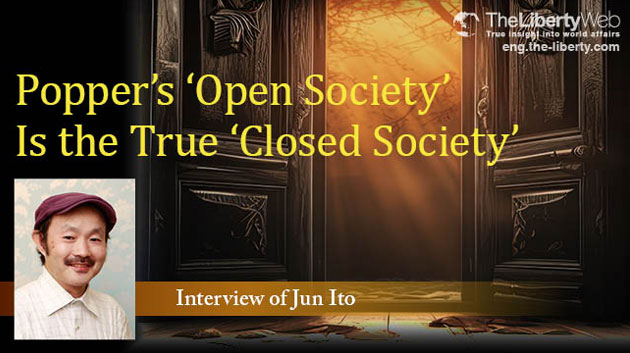
Interview of Jun Ito
Issue with Popper’s criticism towards Plato and Hegel—
(Interviewer: Hanako Cho)
Philosopher Jun Ito
Born in 1962. Completed a doctoral program in Toyo University Graduate School in 2001. Ph.D. (Literature). Translator. His published works include “Why Words Have the Power to Shape Reality” (not yet translated), “The Way to a Superior Man” by D. Deida (PHP Institute). Currently serves as a staff member at the Happy Science Setagaya Branch and also serves as a professor at Happy Science University (HSU).
Q: Many believe that Popper criticized Plato’s philosophy because it tends to lead to authoritarian tendencies like that exhibited by Nazi Germany. What do you think about this?
Prof. Ito: Popper’s personal experience has caused him to believe and fiercely criticize Plato as the source of authoritarianism.
He was born into a Jewish family and lost 17 relatives from the Nazis atrocity. He was a victim of the Nazis. Popper’s book, “The Open Society and Its Enemies,” was written during wartime. I believe it was written more as an effort to fight against authoritarianism rather than for academic purposes.
It was then that Popper traced the ideological origins of Nazism all the way back to the ancient Greek philosopher Plato. In Plato’s major work, “The Republic,” there are several policies that are reminiscent of Nazi government policies. Among them are: 1) governance by a hierarchy of classes and a philosopher-king, 2) the denial of wealth and property by the ruling class and state-controlled education, and 3) the persecution of poets that were deemed morally problematic. It is understandable that Popper, who was acutely sensitive to totalitarianism, overreacted to these depictions. However, his response was strongly rooted in his own personal experiences. It seems pretty clear to me that it was an unfair interpretation of Plato.
Wrongful Interpretation of Plato
First, the philosopher-king is not the fixed, privileged ruling class that Popper describes. “The Republic” explicitly states that talented children may be elevated from the lower classes. Candidates undergo years of philosophical training and examination of character, and the idea is that only those who have distanced themselves far from personal ambition and self-interest take up governance—and even then, reluctantly, at the request of those around them. This is, if anything, a system of virtue-based governance designed to prevent the rise of dictators.
Second, Popper’s logic in equating any restriction on individualism with totalitarianism is simplistic. The communal education and denial of private property for the ruling class were modeled on the Spartan system of government, and we must not ignore the context: Plato was a thinker writing in the aftermath of his home city Athens’ defeat in its war with Sparta, and was emphasizing the necessity of Spartan-style discipline from the standpoint of national defense.
Third, on the question of the expulsion of poets, Popper’s understanding is again excessive. In the context of Socrates’ dialogue, the expulsion is closer to an expression of educational concern. Socrates did not want young people in the ideal state to be exposed to immoral stories, and is not intended as an endorsement of a state censorship system. I believe this is meant to remove undesirable works from the reading lists of the young men who will one day shoulder the nation, not prohibit the teaching of such works to citizens in general. Reading into this and observing a Nazi-style censorship regime is a case of “prejudgment” rooted in Popper’s personal experience.
Popper Criticized Spiritual Beliefs Using Agnosticism
Q: Popper regarded philosophies like Plato’s that acknowledge the Spirit World as a “closed society,” and positioned his own scientific worldview as an “open society.” Can you explain the problem with this thought, with Popper’s religious views in mind?
Prof. Ito: Popper condemned the spiritual world and the world of Ideas presented by Plato as a “closed society” lacking scientific basis and retaining vestiges of primitive tribal society, contrasting it against a scientific “open society.”
It is true that in his essay “Science and Religion,” Popper acknowledged a certain utility in religion. However, he was concerned that if religious and spiritual worldviews were brought into the domain of science, the very foundations upon which science rests would collapse. In this way, he adopted an agnostic position—one that excludes anything from the realm of science if they lack evidence (empirical verification) and cannot withstand fair criticism (falsification).
While this agnosticism may appear to respect freedom of religion, once it reaches the point of harshly denouncing Plato’s Spirit World philosophy as primitive superstition, it must be said that it has gone beyond a position of fairness and neutrality. He actively condemned religion and the Spirit World.
We must not forget that the freedom of speech and public criticism that Popper so valued traces back its roots to the freedom of religion.
Furthermore, Socrates belief that he knew nothing that was praised by Popper was, at its core, a warning against humanity to be humble in front of God’s wisdom. It bears no resemblance whatsoever to the agnostic position that God and the Spirit World cannot be verified scientifically.
Moreover, he placed morality above religion. However, morality is nothing more than a standard of good and evil based on human perspective. When morality and values of nations and different ethnicities clash, a higher perspective of God is necessary to mediate conflicts. Otherwise, we will end up in a world where of the survival of the fittest. This could result in the birth of authoritarian nations, which Popper abhorred.
Meanwhile, it was none other than Plato who successfully refuted the claim that “justice is advantage of the stronger.” In the end, Plato’s philosophy of the Spirit World with a universal ethical system supported by sophisticated philosophical reflection constitutes an “open society.” It would not be an overstatement to say that Popper’s worldview belongs to a “closed society.” It denies the spiritual world and confines us solely to the earthly realm.
Popper Denied Divine Will in History Through Critique of Hegel
Q: It is understandable that Popper pursued the harmful effects of Marx, but he traces that ideological responsibility all the way back to Hegel and subjects him to severe criticism. Are the two thinkers ideologically continuous? Popper also went so far as to denounce Hegel as the greatest scandal in the history of philosophy—how do you view this criticism?
Prof. Ito: At the root of Popper’s harsh condemnation of Hegel is the fact that he detected, within the intellectual lineage running from Hegel to Marx, a dangerous element connected to totalitarianism. The dangerous element Popper identified is “historicism”—the idea that history has inevitable laws, and that in order to realize those laws in this world, an enlightened elite should lead the ignorant masses to revolution. He considered it foolish to attempt to instigate revolution on the basis of such a delusion, since no inevitable laws exist in history.
It is true that with regard to Marx, this criticism is largely apt. Marx, from the standpoint of historical materialism, predicted that when capitalism reaches an impasse, communist revolution will inevitably occur—and it is well known that communists, inspired by Marxist thought, did indeed carry out communist revolutions in the Soviet Union and China.
Popper believed this historicism originated with Hegel. It is true that Hegel’s view of history is grounded in God’s divine plan for the world. However, this is the opposite of Marx’s materialist conception of history. Popper did not understand this difference, and believed that standing in God’s shoes and conceiving world history was the height of arrogance. This is likely why he went so far as to denounce it as the greatest scandal.
However, the above criticism is based on a misunderstanding. Hegel’s true intention was not to usurp the position of God, but rather to prove God’s existence within the unfolding process of world history.
The dignity of human beings are displayed by their ability to believe in a great existence that loves, forgives, and tenderly guides humanity, who have committed many follies throughout history. From a Socratic standpoint, the inability and refusal to believe in such divine will is the true display of arrogance.