The Problem with Popper’s ‘Open Society’ (Part 3) Popper’s Philosophy Falls Short of the Space Age
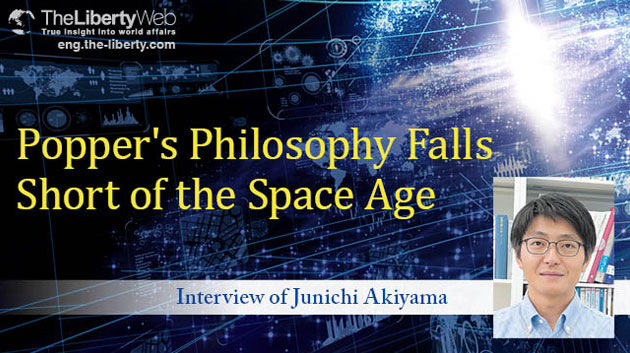
Interview of Junichi Akiyama
Popper influenced modern science. But are there limits to his ideas?
(Interviewer: Hanako Cho)
Physicist Junichi Akiyama
Graduate of Tohoku University Department of Physics. Completed a Master’s program in the Open University of Japan Natural and Environmental Sciences Program. Serving at Happy Science since 2006. Conducts research in theoretical physics and spiritual science. Currently serves as an Assistant Professor at Happy Science University (HSU).
Q: Popper proposed “falsifiability” (*1) as the key differentiator between science and pseudoscience, and established that falsifiability is the foundation upon which science is built.
Assistant Prof. Akiyama: In modern science, the validity of a theory is judged by its reproducibility—experiments should yield the same repeated results no matter who conducts them. This reproducibility is a prerequisite for science to be falsifiable. Therefore, modern science is limited in scope by the fact that its claims must be reproducible through experiments.
However, dismissing phenomena that cannot be verified through reproduction as “unscientific” can be problematic. If one takes the stance that science must be empirical, then there will be countless unexplained phenomena—miracles, supernatural abilities such as telepathy, near-death experiences, memories of past lives, unidentified anomalous phenomena (UAP) and more, which will never be explained.
Rather than closing our minds to these things, I believe that the true scientific spirit lies in exploring the unknown.
Future Science Based on Buddha’s Light Physics
Assistant Prof. Akiyama: At HSU, we are exploring future science that includes the spiritual world. This goes far beyond Popper’s bounds of “rational science.”
This grand universe is made of three elements: light, space, and time (*2).
First, there is the premise that everything in this world and the next world is made of Buddha’s light, and that this light condenses to form spiritual entities.
Next, space is conceived as the field through which light travels, and it is thought that differences in dimensional levels arise due to the degree at which light condenses. To use Lego blocks as a comparison, this three-dimensional world is the low-resolution world that can only be expressed with the largest, roughest blocks. The higher dimensional worlds are made from increasingly smaller, delicate blocks.
Finally, regarding time, I believe we must make a distinction between the earthly “time” that each person feels in this world and the fundamental flow of cause and effect that I refer to as a “chronon” (*3). “Chronons” exist in the spiritual world as well. They create the order of events and the chain of cause and effect. I believe that this flow is created by the works of the tenth-dimensional consciousness (*4).
Time Theory Is Key to Debunking Popper’s Beliefs
Assistant Prof. Akiyama: The part of Popper’s philosophy that I find the most problematic is his treatment of time. Let me explain.
Einstein’s General Theory of Relativity is one of the theories that explains spacetime. Among the solutions to Einstein’s notoriously complex field equations, there is one that is known as the Gödel solution, discovered by the mathematician Kurt Gödel. His solution implies that the unidirectional flow of time from the past to the future is not absolute, but rather is cyclical. This makes time travel, which breaks causality, a possibility.
Physicists are divided on this cyclical interpretation of time that breaks causality. It’s an unresolved problem.
For example, some physicists believe that time travel is impossible due to the principles of quantum mechanics.
On the other hand, physicist David Deutsch, working from the premise of the many-worlds interpretation of quantum theory, argues that while a person could return to the past, they would end up in a different timeline than the one they’re from, so there are no contradictions in causality.
Still other physicists hold that everything is pre-determined, even if time were cyclical. However, this last theory indicates that human beings do not have free will. Because we are taught that human beings have the freedom of choice as well as the freedom to create options (*5), this strict determinism is untenable.
Regarding this problem of causality, Master Okawa has taught us that we can go back to the past through time travel, but we must not drastically alter the chain of cause and effect. We must adhere to the principle that we can “speak, but not directly intervene” (*6).
Furthermore, Master Okawa has stated that the future already exists, and that it can be glimpsed through the power of enlightenment (*7). Therefore, the truth must be that time travel into the past or future is possible, but there is a restriction on the amount of physical intervention that is allowed.
This brings us to a very interesting point.
The experimental reproducibility that underlies Popper’s falsifiability judges the validity of a proposition based on the accumulation of the past. However, if we consider the view that time is cyclical and that the “future” definitively exists, then we must be able to judge the validity of a proposition as seen from the future.
Of course, I believe the method of judging correctness based on past events will still remain. However, the key point is that this is not everything.
If we could determine that something will definitively happen in the future using the theory of time, events that are not reproducible can still be considered scientific. This will drastically change the scope and framework of science. I think it may enable us to handle spiritual phenomena and make a breakthrough toward future science.
The ability to see the future corresponds to enlightenment according to Happy Science teachings. It might be difficult to understand, but people are molding their future on a daily basis. People who want the future to be a particular way will drive the future towardvs that; people who do not care will shape a future in which they are adrift. What is important above all is the will and vision of the future we want.
If the ability to see the future corresponds to enlightenment, future science and enlightenment should converge. In such a world, Popper’s philosophy that denies the spiritual world and spirits will not be able to understand the essence of time theory that assumes a spiritual world.
A true “open society” must encompass the higher-dimensional worlds of the fourth dimension and beyond as well as this three-dimensional world. I believe that such science is required for the world to enter the Space Age.
Warp Technology and the Memory of a Soul
Q: You talked about evaluating the truthfulness of present science from the perspective of the future. What do you think about the mechanics of warp technology that enables us to jump to the future?
Assistant Prof. Akiyama: We must discuss the concept of “recognition” first.
Earlier I mentioned that each of our thoughts shapes the future, but the reality we perceive is grasped through the medium of physical matter. The future that branches out into a couple of different directions is recognized as a singular reality based on the processing of the physical world. However, if one were able to recognize two things simultaneously when perceiving a given situation, the world would appear to exist in parallel. This is key to the discussion of recognition.
The other part to this is the relationship between “warp technology” and “the enlightenment of selflessness.” If one pursues the enlightenment of selflessness, Happy Science teachings state that they can reach a point in which one’s being can be dissected into molecules, into atoms, into elementary particles, into photons, and even into a smaller particle that we call spiritons. One can teleport through space and time if they can reassemble those particles using memory (*8).
Now, where does that “memory,” which is used to restore the original form, reside? The mystery of memory is an unsolved problem in modern neuroscience. Based on Happy Science teachings, memory lives in the part of our mind known as the “memory tape” (*9), and it is more natural to interpret the brain as a device that reads this tape as memory in this three-dimensional medium.
In addition, we are taught that the extent to which we can recall our past lives depends on one’s spiritual level (*10). When we recall a memory, we instantaneously point the needle of our mind from the present to the past and remember the past self as though they were in the present. This means that spirits residing in the higher dimensions can shift their minds to a more distant point. We have been taught that the mechanism behind warp technology that enables space travel and the mechanism behind time travel that allows us to move between the past, the present and the future are similar (*11). I hypothesize that each individual’s ability to travel through spacetime is limited and related from this perspective.
The enlightenment of selflessness that is required for time travel is the ability to go into a meditative state, understand at the deepest level that you are an intentional spiritual energy materialized by the Creator’s will for you to exist (*12), and reconstruct that being in the space and time that you determine to be your destination. The speed of travel here will not be constrained by physical limits, so faster-than-light spiritual velocity can be attained.
Faith Connects the Present to the Destination
Assistant Prof. Akiyama: It is also said that “the power that instantly transfers you to your destination is the power of faith. ” This is because faith allows us “to close the gap between your current thought and your final goal. ” (*13)
From this perspective, “faith” that Popper dismissed as the catalyst of a “closed society” is something that will advance future science. In addition, it seems to me that we are entering an age where it becomes imperative for spiritual enlightenment and science to advance together.