Donald Trump, the Strategist: Contain Iran, Corner China
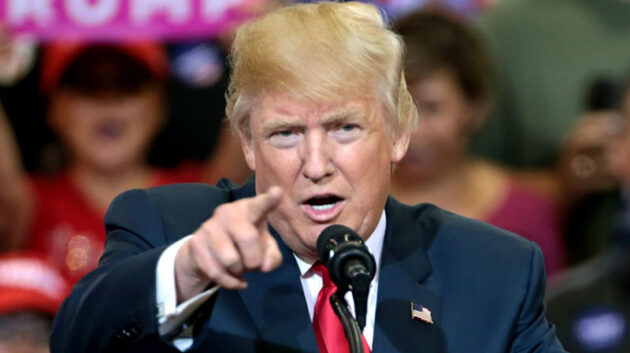
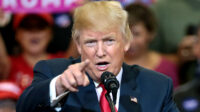
Photo:”Donald Trump” by Gage Skidmore is licensed under CC BY-SA 2.0.
It is said that Iran had calculated that if it blockaded the Strait of Hormuz and held the global economy hostage, President Donald Trump would be unable to withstand the resulting economic damage and would be forced to back down.
However, the media have failed to fully grasp President Trump’s true intentions. Rather than acting on impulse, President Trump must have factored in some degree of economic damage in advance, resolved to see things through until he accomplishes the two major objectives below.
Objective No. 1: Military Intervention Is the Only Way to Prevent Iran’s Nuclear Development
The first of President Trump’s aims is to eliminate the threat posed by Iran and force it to abandon its nuclear armament.
Originally, U.S. diplomatic policy toward Iran up through the Obama administration rested on an exchange: halting nuclear development in return for relaxed economic sanctions. This was the same approach taken in negotiations with North Korea, and many Japanese still remember that dialogue with North Korea failed to stop its nuclear armament.
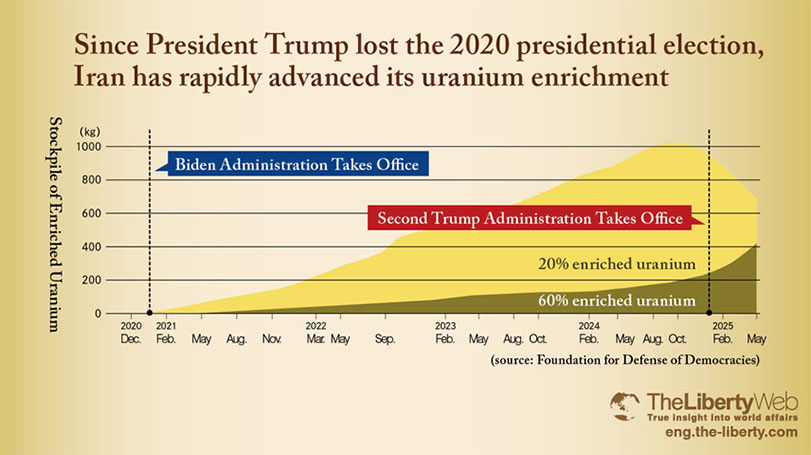
Because Iran took the same approach as North Korea, the first Trump administration applied maximum pressure. However, as the previous Biden administration concentrated on supporting Ukraine, Iran’s current regime survived and pressed ahead without pause on uranium enrichment – technically the most difficult step – eventually amassing enough uranium for roughly ten nuclear weapons. By the time the second Trump administration took office, Iran’s acquisition of nuclear weapons had become imminent.
Even in the negotiations that followed, Iran continued to offer effectively no concessions, and judging that talks would go nowhere, President Trump found himself with no choice this time but to physically halt the program. What matters, however, is that, just as President Trump’s guardian spirit once stated, “Stop making nuclear weapons…if he (Mr. Khamenei) agreed with me on this point, we can be good friends” (*1), President Trump still believes today that Iran could become a friendly nation if they genuinely change their thinking.
Objective No. 2: Cutting China’s Belt and Road Lifeline
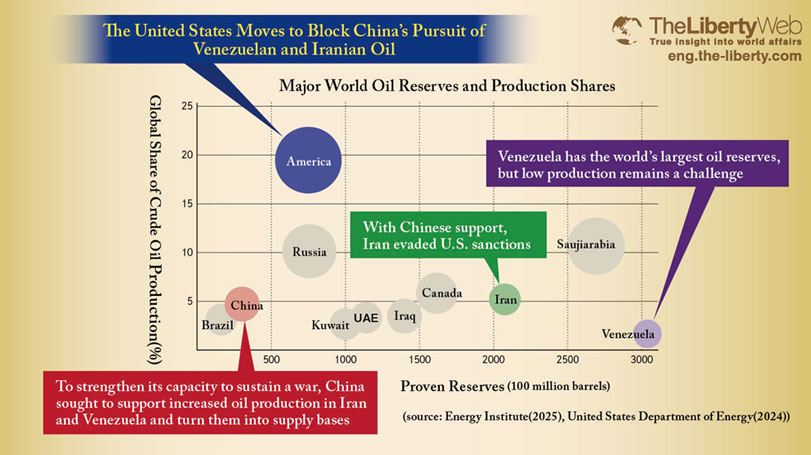
The second objective rested on the strategy that, since China securing and increasing oil production in Iran — a key node of the Belt and Road Initiative — would allow it to build a war-ready posture, President Trump needed to cut off China’s oil supply base.
China has been waging a diplomatic offensive toward anti-American countries around the world, and Venezuela and Iran in particular were attractive targets given their abundant supplies of cheap oil. Venezuela holds the world’s largest oil reserves and Iran the third largest, and with sufficient technology and investment, both could increase production significantly further.
China has tried to bolster these countries through the Belt and Road Initiative. If Venezuela and Iran were able to produce oil at levels comparable to Saudi Arabia, China would be able to cover the entirety of its oil imports from them. Because China’s Belt and Road drive to secure energy is, in essence, “a defense concept built for war” (*2), President Trump’s guardian spirit clearly stated that he “want to destroy the “One Belt, One Road” strategy” (*1). With the attack on Iran following that on Venezuela, it is reasonable to view this as the start of a full-scale effort to dismantle the Belt and Road Initiative.
The Road Not Taken: Iran Would Intervene in Taiwan Affairs and Restrain Japan
Conversely, what would have happened if President Trump had left Iran alone without attacking it? At the very least, the following two new threats could be expected to emerge.
In numerous Dharma talks and spiritual messages, Master Ryuho Okawa, Founder of Happy Science, has repeatedly addressed the problem that if China gains control of Middle Eastern oil, Japan’s energy supply would dry up. In particular, the guardian spirit of Chinese leader Xi Jinping, in early 2012, right after it had effectively been decided that Xi would become president, spoke of linking Japan’s anti-nuclear movement with a Middle East crisis and the blockade of sea lanes in order to corner Japan (*3).
“Of course I did! It’s an obvious strategy, because the sea lanes are an issue where Chinese and Japanese interests will eventually clash.”
If cooperation between China and Iran were to deepen, China could have Iran carry out a diversionary operation and then invade Taiwan.
At present, Japan, South Korea, and the Philippines, all of which would be involved in a Taiwan contingency, are heavily dependent on Middle Eastern oil. It would not be surprising if China believed that having Iran exploit that “weak point” and block tankers bound for Japan and elsewhere could prevent support for Taiwan.
The Bigger Danger: Beijing’s Nuclear Umbrella Over the Middle East
What is alarming is the view, tied to China’s national strategy, that the true aim of China’s abnormal nuclear buildup is to “drive the United States out by offering Middle Eastern countries a ‘nuclear umbrella.’”
The U.S. Department of War projects that China will possess 1,500 nuclear warheads by 2035, matching the number deployed by the United States. But if the goal were simply to destroy the United States, more than 1,000 warheads would not be necessary.
The spirit of Qin Shi Huang, the First Emperor of Qin, has stated: “We will fully cover the Middle East with China’s nuclear power. If we can protect them from both Europe and America, then the countries of the Middle East will end up in the same position as Japan is under American control. Well, I do intend to more or less keep a hold on the ‘kitchen that supplies our oil.’” In this way, he lays out a long-term vision in which China, by offering a nuclear umbrella to the Middle East, would effectively present itself as “Allah” (*4).
If that were to happen, dictatorships such as Iran would survive, and one country after another could end up submitting to China. The United States, by all means, had to strike a blow against Iran’s pro-China regime.
Even the Enemy Agrees: A Dead Commander’s Verdict on Trump’s Strategy
Interestingly, the guardian spirit of Commander Soleimani of Iran’s Islamic Revolutionary Guard Corps, who was killed in a 2020 U.S. military strike, offered a calm assessment that President Trump’s Middle East policy was strategic (*5).
“If Mr. Trump’s final goal is to crush China, then it’s important to secure the oil, of course. If the U.S. rules over the Middle East, China cannot get oil, so it’s very bad for China.”
“But in the end, his final strategy is to rule the Middle East, which is Europe and China’s vital point. This is his world strategy. So, he’s quite wise, I think.”
Both President Trump’s attack on Iran and his statements about wanting to control Iranian oil stem from the major objectives described above, and it is worth understanding that they also carry the aspect of averting a worst-case future.