Inheritance Tax Reveals the True Nature of the State
An Interview with Dr. Arthur B. Laffer

The Liberty December 2026 Issue
Dr. Arthur B. Laffer achieved significant tax cuts through the TCJA and the OBBB under the Trump administration. How does he view Japan’s inheritance tax?
(This interview was conducted on September 16th. Interviewer: Hanako Cho)
Cho: Thanks to your de facto elimination of the estate tax under the TCJA, which was made permanent under the OBBB, the federal exemption has expanded to a record-high $15 million ($30 million for married couples). I think this is a tremendous achievement. Considering that the exemption was only $670,000 in 2001, this represents tremendous progress. You have advocated for abolishing the estate tax more than anyone else. In light of this achievement, I’d like to ask you once again about the importance of eliminating the estate tax. First, what do you think motivated President Trump to reduce the estate tax rates so dramatically?
Dr. Laffer: That’s the one tax I’ve always hated. You make a lot of money. You become really famous. You become rich, and you want to give it to your kids. What’s wrong with that? Why should I go in there and say, “No, you can’t. I want the money you earned”? That’s wrong. And why would you ever want people to choose smoking, drinking, carousing, and gambling over leaving money to the next generation? Why would you ever do that? President Trump did a great job on the death tax and the Tax Cuts and Jobs Act. That was my favorite provision, of course, as you know.
But the death tax is one of the few things that really sheds light on the soul of a government. It really does. Why would you ever go after successful older people?
The death tax is nothing but jealousy. It reflects the intentions and character of those who impose it. It’s one of the most vile taxes I’ve ever seen in my life.
Sweden, Which Has No Inheritance Tax, Is No Longer a Socialist Country
Cho: As shown in the figure below (from Unleash Prosperity), Japan’s marginal inheritance tax rate is 55% on estates exceeding 600 million yen—the highest in the world, it is said. In 2013, Japan revised its inheritance tax deductions, further lowering the tax-exempt threshold. Today, more than one in ten people pay inheritance tax. How do you view this situation?
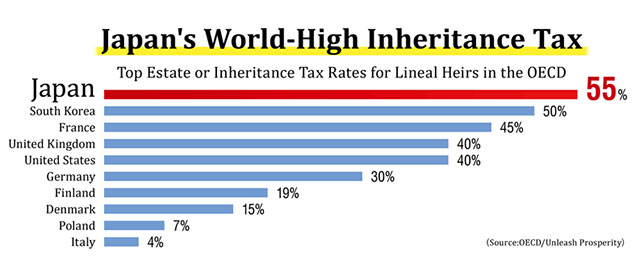
Dr. Laffer: This table shows the top estate and inheritance tax rates for lineal heirs in OECD countries. You need to include Sweden. Do you know what Sweden’s inheritance tax rate is?
Cho: Zero, since it was abolished.
Dr. Laffer: Sweden’s gift and estate taxes are zero. You can give anything you want to anyone without any tax consequences. I’m going to send you the paper Joel Citron and we are publishing today about Sweden. The reason I want Sweden included is that everyone says, “You say socialism doesn’t work, but what about Sweden? It’s a socialist country, and it’s prosperous.” Well, Sweden isn’t a socialist country. A country with no estate tax, no gift tax, and a very low corporate tax rate isn’t socialist.
You say that 600 million yen is the threshold at which the highest marginal tax rates (55%) begin to apply. It’s about $4 million. A $4 million threshold is outrageously low. For example, in the United States, estates are exempt from the tax up to $30 million. Japan’s highest rate is astonishing.
Gambling Has Lower Tax Rates Than Leaving Inheritance Behind
Dr. Laffer: Now, taxing an estate is really disgusting. Think of it this way: You earn your income and pay your taxes fair and square. You pay taxes on your earned income, your unearned income—all of it. You’ve paid them all. You’ve done your part. At that point, you have a choice about what to do with your after-tax income.
Here’s how I make the argument: If you take that money and go to Las Vegas, carouse with disreputable people, smoke, drink, do drugs, and gallivant around, that’s your money as far as the federal government is concerned. You can do with it as you see fit. There are no tax consequences.
But if you take that same money and give it to your children, someone else’s children, or anyone else, you’re faced with a 40% tax rate on the margin. That rate only kicks in at a very high level, but it still makes no sense.
A country’s whole dream is to use the wealth of the current generation to benefit the next generation. In other words, why do we have good schools? To make the next generation better off. Why do we have all these other programs? Why do we subsidize investments and so on?
The purest way to help the next generation is to pass on the assets you’ve earned without them being taxed. So, I think this is perhaps the most vulgar tax in the entire tax repertoire. It has a very small tax base and a very high tax rate, especially in Japan.
Cho: Yes, we have the highest inheritance tax rate.
Why Is Estate Tas the Perfect Example of a Bad Tax?
Dr. Laffer: And you also have the smallest tax base: 4 million. That’s why I wanted you to include the figure. It’s $4 million, compared with $30 million in the United States.
So you’ve made the tax base tiny, and then, bam, you tax those people. In the United States, I think revenues from the death tax make up less than 1% of total federal tax revenue.
It’s a very small tax, with a very high rate on a small base, the perfect example of a bad tax. You want a tax on the broadest possible base at the lowest possible rate, not on the smallest base at the highest rate. You don’t want to do that. So, in every sense of the word, I think the inheritance tax is probably as bad a tax as we’ve ever had. It reflects nothing but jealousy, selfishness, and envy. It’s as if all the worst traits of humanity conspired to create this wealth tax. It’s imposed by jealous, bitter, nasty people who resent those whose parents, grandparents, or other relatives were successful. So, it says a lot about the character of a country that would impose such a tax. It’s a vile, vile tax.
I don’t mean to be nasty about Japan, but there’s something very unwholesome, putrid, and nasty about a country that says, “You have too much money, so you can’t leave it to your children.” Maybe that’s why there aren’t many children in Japan. I mean, they’ve waged war on children in Japan. You see what I’m saying?
Virtue Signaling Goes Against Human Nature
There’s another side to this that I intensely dislike: virtue signaling. It goes something like this: “Well, they didn’t earn it. They shouldn’t have it. They should be forced to make it on their own. We should level the playing field with every generation so that the children of the poorest are equal to the children of the richest, with no one having an advantage.”
That’s not the way the world works. The world has mothers and fathers, and people who aren’t mothers or fathers. By the very nature of biology, mothers and fathers are there to protect, provide for, and nurture their children above others.
I have six children, as you know, and 14 grandchildren and four great-grandchildren. I’m sure I would love anyone else’s children, grandchildren, and great-grandchildren. I’m sure I’d love them—but I love mine more.
The reason I get up every morning and work at 86 years old is for them, not for anything else. I don’t need the money. I do it to make their lives better, and that’s my incentive. My incentive isn’t the same as that of a child whose parent lives in Zimbabwe. That child isn’t mine, and I just don’t feel the same way about them as I do about my own. That feeling extends beyond my immediate family, too—literally beyond my own. But, basically, that’s the virtue signaling at work here, and it’s directly opposed to incentives, nature, and everything else in society.
Tennessee’s Economy Soars After Abolishing the Estate Tax
Cho: You compared U.S. states with and without inheritance taxes. I believe you published a study titled “The Seven Deadly States,” showing that states without an inheritance tax are attracting high-income earners, while states with one are losing them (see chart below). The chart is very telling. I believe Tennessee abolished its inheritance tax thanks to your efforts. Could you share your experience from that time?
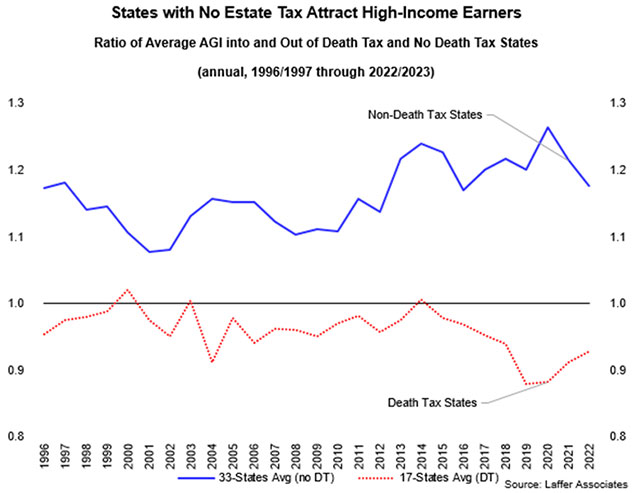
Dr. Laffer: When I moved to Tennessee, it was one of only two states in the United States that had both a gift tax and an estate tax. I didn’t know that when I moved here. Connecticut and Tennessee were the only two states with both taxes, and the rates were high. I’ll tell you my story.
When I left California, I had to sever all my ties with the state to avoid being taxed as a California resident. I couldn’t live there, own property there, or have employees there. Any of those things could have been taken as a sign that I intended to return and remained a California resident.
I worked with lawyers to ensure that, when I left California, I severed my ties with the state legally, completely, and entirely, so that I would be a Tennessee resident. I paid taxes in Tennessee as a Tennessee resident, not in California. That meant I had to get rid of all my California employees, which I did. Some moved with me, and I had to let the others go.
I also had to get rid of my properties there. I had a large home on 17 acres in Rancho Santa Fe, which is a lovely place. I tried giving it to my kids.
I gave it to Allison and Justin, but they didn’t want to live there. At the time, Allison was working at Nicholas-Applegate in San Diego, which was a client of mine. She was doing really well. I was here in Tennessee, where we have no income tax. We did have an unearned income tax, which we later got rid of, as well as a gift and estate tax, which I wasn’t aware of. I told my lawyer, “Well, I had to sever all my ties with California.”
I had to get rid of everything. I had to fire all the employees I had there and get rid of my lawyer there. I had to eliminate anything that might suggest I intended to return to California—including my property. I gave it to my two youngest children, Allison and Justin.
And my lawyer said, “You what? Oh, no—you didn’t do that.” I said, “Well, yeah, I did. What’s the matter?” He asked, “Aren’t you aware that there’s a gift tax here in Tennessee?” I said, “Well, no. I didn’t know that.” Oh my god—the gift tax in Tennessee wasn’t small. It was really high: 15% on a gift. And that California property was quite valuable. My lawyer said, “Oh my god. Let me see what I can do.”
He looked into it and called me the next day. He said, “”The Lord be blessed. There’s an exception to the gift tax for out-of-state real property”—which is what my property was. It was real property outside the state that I gave to my kids, so they didn’t have to pay the gift tax. The tax had come dangerously close to catching me, and I hadn’t even known it existed.
Then I got to work to eliminate the gift and estate tax in Tennessee. We succeeded. We got rid of it. But that’s the story of how I got involved in Tennessee’s gift and estate tax. I conducted the Tennessee study on the gift and estate tax.
The study you cited is a great one because it includes all the other information as well. But when Tennessee had a gift and estate tax, people here would move to Florida if they got sick, taking their homes, businesses, and everything else with them. As a result, we were the worst-performing state with no income tax in the nation. We really were.
When we got rid of the gift and estate tax—I think that was in 2012—bam! We started growing like a rocket ship. It was amazing. Wealthy people no longer had to leave and take their money with them.
You can see that in the figures: the average adjusted gross income of people moving in and out, the number of estates, and more. Not only were estates in Tennessee smaller than those in Florida, which has no gift or estate tax, but they were a lot smaller. And the number of estate tax returns filed per 100,000 people was also much lower in Tennessee.
So not only did many people leave for Florida, but they were the wealthy ones, the really wealthy. That’s amazing. As you mentioned in “Get the Hell Out of Here”, I looked at all the states with estate taxes and those without them. You can see the differences in the averages. All those figures are in your paper, and you’ve quoted them correctly. It’s amazing how sensitive wealthy people are to death taxes. It’s the most vile tax of all.
We have all the revenue figures. It is one of the few taxes that is hugely in the Laffer Curve effect.—hugely so. Getting rid of the death and estate taxes increased Tennessee’s tax revenues enormously. It did reduce gift and estate tax revenues somewhat, but people who didn’t leave paid property taxes, sales taxes, income taxes, and so on. The overall revenue feedback was an enormous net positive for Tennessee and for other states as well. You’ve included all those figures, and I love what you’ve described here. This issue needs to be brought to light. Now, how do they get around it?
The Reason Behind Japan’s Tendency to Dismiss Successful People?
Cho: Japan’s tax authorities go after people. One in five people who pay inheritance tax is subject to a national tax audit.
Dr. Laffer: They go after people here, too, but not nearly as often. You have a country right now that is very hostile toward people who succeed. I used to say it was France, but now I think it’s Japan. I tell everyone that the French hate everyone—but most of all, they hate themselves. They’re very jealous of anyone in their country who does well.
I served on the board of Vivendi Environnement with Jean-Marie Messier. You may remember that from a long time ago; I’ve told you that story. I was the only American on the board of this huge French company, which was the 99th-largest in the world and France’s water company. It became very clear to me that the French hate everyone, but they hate themselves the most.
It’s called the tall poppy syndrome: they can’t stand seeing another French person succeed. They say, “How did they do that? They must have stolen or cheated.” There’s an element of that in Japan, too. Japanese people can be very suspicious of fellow Japanese who are doing well.
Cho: You know a great deal about Japan.
Dr. Laffer: Well, it comes from another thing they do. And this is something I don’t dislike—I really don’t. I don’t dislike it in America. I may dislike it more in Japan. Japan is very anti-immigration; people there don’t like immigrants coming into the country. I can understand Japan’s position on that very well. It has an indigenous ethnic Japanese population that is very distinct.
Cho: Yes, we’re a homogeneous society.
Dr. Laffer: A very close-knit society, but one that’s very different from the rest of the world. If Japan weren’t different, the world would lose an enormous asset. If Japan became like every other country, we’d lose some of the wonderful qualities it has today. We really would.
I just watched the Tom Cruise movie The Last Samurai—about two or three nights ago.
The whole thing about the samurai, the temples, and their beauty—I mean, there’s something really, really special about Japan. It’s something I wouldn’t want to see disappear. That’s my view, and I think I speak for the world: Japan is a unique culture, a unique and special group of people who contribute a great deal to the world.
Now, if the U.S. were to become anti-immigrant—which we are not—that wouldn’t mean letting 45 million people in in a single day. But we do allow many people to come here. We aren’t unique and special in the way Japan is, or in the way the Ibu tribe in Africa, the Maasai, or some Chinese populations are. We’re really a conglomeration of peoples.
When you ask, “What is American culture?” there isn’t just one answer. It’s not that we lack culture; it’s that we don’t have one uniquely American culture. We have German culture, French culture, Japanese culture, Russian culture, and African culture.
I mean, we have all these cultures around us. They’re all part of our society, but we aren’t the protectors of any one culture. These cultures can dissipate quickly. So, when I look at anti-immigrant sentiment in the U.S., I see it as bad behavior. It’s selfish and unpleasant. I don’t view Japan’s anti-immigrant stance the same way. I just don’t. In fact, if you became like the United States, I’d never visit Japan again. You know what I’m saying?
One thing I do have a problem with in Japan is that Japanese people don’t seem to like themselves. There’s a hostility toward Japanese success, and I think it may come from the war. As you know, I lived in Germany when I was young and attended the University of Munich. I even received the university’s Alumnus of the Year award. Let me tell you a story about the Germans, because it’s similar to how I see Japan.
When I was young, I’d ask people at a youth hostel, “Where are you from?” One would say, “I’m from France.” I’d ask someone else, “Where are you from?” “I’m from Spain.” “Where are you from?” “I’m from Canada.” “Where are you from?” “I’m from South America.” “Where are you from?” “I’m from Europe.” I’d say, “What? From Europe? You must be German.” “Oh, yes. I am German.”
There was a sense of shame that came from the war. After the war, Germans were very ashamed of being German.
Cho: A feeling of guilt.
Dr. Laffer: It was a feeling of guilt—a terrible feeling of guilt. “Ich bin Deutsch und stolz darauf”—“I’m German, and I’m very proud of it”—is one response. But there’s also: “Sechs Millionen Juden auf meinem Kopf”—“Six million Jews on my head. Oh, my God. I’m so ashamed.”
I think there’s an element of that in Japan, too. It should be fading, since 1945 was a long time ago. Still, I think some of it remains in Japan, along with some self-hatred and disrespect for one another. I’m not sure how to put it—maybe I’m not expressing it correctly—but I think it shows up in the high tax rates and the wealth tax. It also shows up in the inheritance tax: “Who are you to have all that money? You don’t deserve it. You’re no different from me. Cut your head off.”
Then there’s the problem of virtue signaling. The death tax brings this into focus. It’s a perfect litmus test for jealousy, selfishness, and virtue signaling. I’ve said my piece, so I’m going to stop.
It’s like the wealth tax in California. We’ve discussed this at great length. If it passes, four people will pay $100 billion in wealth taxes. All four are older, white Jewish men. What could be more discriminatory? I mean, what they’re doing is disgusting.
Cho: I totally agree with you.
Abolish the Inheritance Tax and Adopt a Flat Tax
Cho: What should the ideal tax system look like with respect to death taxes?
Dr. Laffer: When discussing death taxes, I’m not going to distinguish between an estate tax and an inheritance tax. An estate tax is levied on the deceased person’s estate, while an inheritance tax is levied on the people who receive the money.
There’s a strong argument for taxing the recipients. In other words, under the low-rate, broad-based flat tax we’ve discussed, people who inherit money would pay ordinary income tax on their inheritance. That would be the right approach.
Income from any source should be taxed at the same low rate. Under Jerry Brown’s flat-tax proposal, for example (remember, we’ve discussed it), that rate would be 13%. It shouldn’t matter where the money comes from. But receiving money from an estate shouldn’t mean being taxed at a higher rate. There should be no estate tax; only the recipients, the inheritors, should be taxed.
They don’t have to be family members. They could be foundations or any other kind of recipient. Anyone who receives income of any kind should pay the low-rate, broad-based flat tax. So in that sense, the inheritance should not be distinguished from anything else whatsoever to have a correct tax system.
How You Treat Successful People Lays Bare Society’s True Feelings
Dr. Laffer: This topic is really important. It’s like a tunnel, a small opening with a bright light that reveals the inner soul of a people. Now the darkest corners are being illuminated. How you treat your own successful people, their children, and so on, really lays bare the true inner feelings of the society. And what it reveals about Japan isn’t pretty. It’s not pretty, Hanako. It isn’t. What’s wrong with a country that treats its successful older people this way when they die? What is wrong with it?
This is a model of self-loathing. And you are a wonderful, wonderful people. I’ve said this to you a thousand times, but let me say it again: Japan is a gem on this planet.
The Japanese are not bad people. They are good people. The world would be much poorer without Japan. You should love yourselves, and you should take pride in people wanting to help their children. You should take pride in Japanese people wanting to become richer, better, and more prosperous. You should take pride in Japan wanting to be a player among nations. You should take pride in being Japanese. . Be proud, proud, proud.
Cho: Thank you.
Help the Poor, Don’t Hurt the Rich
Dr. Laffer: You have the best culture. You have samurai, art, and so much more—no one else has that. Love yourselves, Japan. Don’t hate yourselves. This death tax is a sign of absolute self-loathing and hatred.
And thank you for pointing this out, because I never would have thought of it. I don’t usually think of Japan and death taxes. I do think of the U.S., because it has them. But I really started thinking about this when you sent me all that information. Where are the states that still have death taxes? They’re the bad states. They’re the states that hate their children and themselves. They’re saying, “I don’t like that rich person over there. Kill that rich person.” No. They’re not states that help the poor. There’s nothing wrong with being rich. Nothing. There is something very wrong with being poor.
Help the poor; don’t hurt the rich. This is 100% about hurting the rich. It shows the ugliness of jealousy, self-loathing, and virtue-signaling bad behavior.
But please, love Japan. I’m not Japanese—I’m an American. I love the things I do with The Liberty and everything else in Japan. I really do love, love, love Japan, as you know. Some of my best trips ever have been to Japan. I think it’s a phenomenal country. I’m a stranger there, a foreigner, and I’m not treated the same as a Japanese person, but that’s fine with me. I love, love, love how you treat your people. There’s just one thing: don’t hate yourselves. Stop it already. Love yourselves. Be rich. Make your poor people rich. Let older people work. They shouldn’t be living on pensions and benefits while smoking their cigarettes. No, they’re just like me. I’m much older than most Japanese retirees, and I’m working. Why the hell can’t they?
Just because people are old doesn’t mean they shouldn’t work. They have wisdom, knowledge, and experience. These people should be in the labor force—not sitting at home. You know what I’m saying?
The Elderly Have an Important Role
Cho: You’re a role model for people who hope to age healthily.
Dr. Laffer: The Japanese have wonderful older people. I see them in BBC interviews and on TV—the older people who preserve the old ways. They’re wonderful. They should be working, not sitting in retirement, walking along the beach with a stick and collecting seaweed. They should be working. Of course, they shouldn’t be driving trucks at 80 miles an hour down the freeway. But they should be advisers. They should be sources of wisdom and guiding lights—the ancient spirits who help make sure young people are heading in the right direction and using the best tools.
Older people have a really important role. Japan is throwing away its older people, its successful people, and its children. That’s self-loathing. A government that does that should be thrown out and sent to Siberia. You see what I’m doing in Spain and Britain. It’s the same thing. We need to reform Japan soon. You love Japan, don’t you?
Cho: I don’t like the way things are right now.
Dr. Laffer: I don’t either. I want government to treat the Japanese people well. That means the government shouldn’t tax people who work and pay people who don’t. That isn’t treating people well. It shouldn’t take away the wealth people have earned and prevent them from passing it on to their children. That isn’t right, either. The government shouldn’t hate the Japanese people.
Any government that taxes workers and pays non-workers hates its country. It subsidizes the worst elements of society and penalizes the best. That’s not the right way for a government to act.