Japan and India Should Work With the US and Asian Nations to Deter China
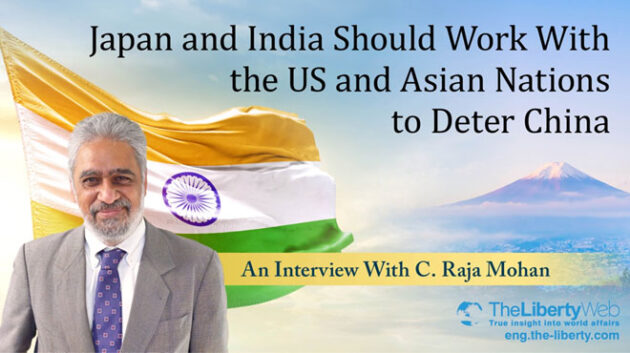
An Interview With C.Raja Mohan
A Leading Indian Strategist on China’s Military Rise and Why New Delhi and Tokyo Need Each Other More Than Ever
C. Raja Mohan is one of India’s foremost voices on foreign policy and security. He is a distinguished professor at the Motwani Jadeja Institute for American Studies at O.P. Jindal Global University and a columnist for Foreign Policy magazine. In an interview conducted in New Delhi in August, Dr. Mohan discussed China’s growing military assertiveness, the volatility of U.S. policy under President Trump, and why he believes India and Japan must deepen their own cooperation rather than rely solely on Washington. The interview has been condensed and edited for clarity.
Interviewer: Mayuko Kataoka
China’s Military Rise and Its Consequences for the Region
Q. Could you share your views on China’s current military strength and its influence on countries around the world?
Dr. Mohan: I think we are at a very critical juncture in Asia and the world, as the consequences of China’s economic rise begin to unfold. Thirty years ago, a lot of people believed that if China’s rise were peaceful, it would become just an economic giant without military ambitions — that China would integrate itself into the international system. Many of our American friends argued China would become a responsible stakeholder, with no interest in breaking the international order.
I think the mistake was failing to see China’s actual aspirations. China didn’t want to be just an economic power or the world’s factory. It wanted to be a great power, one that shapes the international system.
Today, people are surprised that China is willing to use military capability to transform its neighborhood, alter territorial arrangements and assert itself as a great power. We should have seen this coming, but much of the world didn’t. Now that China is a rich nation, it has also built a powerful military, backed by heavy investments in science, technology and military modernization.
While China still cannot match the United States globally, its dominance in the Western Pacific and Asia gives it enormous advantages. As Chinese power grows within the region, it creates complications — both for American forward military presence, which Washington once assumed would go unchallenged, and for China’s neighbors. Even Japan, which was economically larger than China three decades ago, now faces an asymmetric challenge. So does India.
From Shared Anti-Imperialism to Strategic Rivalry
Q. How many people in India are aware of the possibility that closer ties with Beijing could come at a cost, given China’s political system?
Dr. Mohan: I don’t think we should think in terms of how many people, because India is a country of more than 1.4 billion. I’ll speak to elite perceptions instead.
During the independence movement, Chinese and Indian nationalists believed they could work together to change the world, united by anti-imperialism. But when that idea was tested in World War II, it fell apart: China was fighting imperial Japan, while the Indian national movement was fighting British imperialism, and Britain and Japan were at war with each other. A seemingly good idea did not survive contact with reality. Through the Cold War, India and China remained on opposite sides.
In the 1990s, with the arrival of a unipolar world, there was a brief, broadly held consensus in India that it should work with China to help build a multipolar order. But since then, Chinese power has grown dramatically. Today China is the second-largest economy in the world, nearly a peer to the United States.
That has complicated the old assumption that India, China and Russia could work together to check American unipolarity. Indian strategy has shifted accordingly: we still want a multipolar world, but what matters more now is a multipolar Asia. India cannot accept an Asia dominated by China. That means we need the Americans to help balance China, a shift over the past two decades from treating American power as the problem to treating Chinese power as the problem, particularly given our unresolved land and maritime boundary disputes.
That’s the direction Indian policy has moved in over the past decade — the revival of the Quad and closer India-U.S. cooperation. What’s shocking people now is that it’s no longer clear where America stands. President Trump’s policies are uncertain. We shifted from trying to work with China, to watching China grow more assertive and our border disputes worsen, to working with the U.S. and its allies to balance China in the region. Mr. Trump’s first term actually embraced that — talk of the Indo-Pacific, revival of the Quad — and the Biden administration continued strengthening it. But today, we don’t know where Mr. Trump is taking U.S. policy.
There is real volatility in American policy now. Mr. Trump talks about a “G2” and has been eager to build a relationship with Xi Jinping. Whether he places the same value on allies like Japan, or partners like India — India is a partner, not a treaty ally — is unclear. We are in a situation where the China challenge remains, but it is uncertain whether the U.S. has the political will to address it, at least under the current administration. That may not even be the policy of the next one. Washington itself has grown ambivalent, partly because Chinese power has grown; how the U.S. deals with China is going to keep changing.
This is why India and Japan need to strengthen themselves in Asia, while also doing more with each other, and with Australia, South Korea and Vietnam. If we share more of the burden of securing the region, it also becomes easier for Mr. Trump to sustain a coherent policy.
Japan’s Security Awakening: Abe’s Legacy and the Asymmetric Strategy
Q. Could you elaborate on your views on Japan’s security policy?
Dr. Mohan: I’d point to three things. Going back to former Prime Minister Shinzo Abe in 2012 — I think Mr. Abe was the first to see the China problem in a way that neither the Americans nor we ourselves did. His 2007 call for Asian democracies to work together laid the groundwork for the idea of the Indo-Pacific. That was, in a sense, the first real signal that the region needed to rethink itself considering China’s rise. Japan has shown real leadership here. We tend to think of Japan as passive, but over the past 15 years it has led in imagining new regional institutions.
Second, over the past five years Japan has been very purposeful in recasting its own policies — defense reform, constitutional debate, rebuilding its defense industrial base. The 2022 documents on budget, doctrine and strategy marked a significant change from how Japan behaved for most of the postwar period.
Third, Japan is developing asymmetric strategies, recognizing that China is stronger and figuring out how to deal with that reality. Japanese investment in underwater technology, drones and related capabilities is going to make an enormous difference.
Unlike many countries in Northeast Asia, India has never had a quarrel with Japan’s prewar history; nobody in India is demanding apologies over Japanese militarism. In fact, during World War II, a section of the Indian elite worked with Japan to defeat British colonial rule. Even Jawaharlal Nehru, India’s first prime minister, was clear that Communist China should not be isolated internationally, but he said the same of Japan, insisting Japan could never be treated as an enemy state at the United Nations. India gave up its claims to reparations from Japan.
So for India, a strong Japan has always mattered, and it is genuinely heartening to see Japan taking a leadership role, politically, militarily and doctrinally. There is room for a lot more India-Japan collaboration.
Deepening India-Japan-Australia-Korea Ties
Q. You’ve written that India should simultaneously engage Washington on defense while enhancing strategic collaboration with regional powers like Japan, South Korea, Australia and the ASEAN countries. Could you elaborate?
Dr. Mohan: America, as we’ve discussed, has become very volatile. Mr. Trump talks about a G2, about wanting a great relationship with Mr. Xi. That doesn’t mean India should conclude it shouldn’t depend on the U.S. at all — as a matter of first principles, there is no way to balance China without America. We must maintain the relationship with Washington and make the most of whatever cooperation is available. I know that’s the policy Japan is following, and India should do the same.
But we also need to reduce our dependence on the Americans. It is increasingly clear the American taxpayer is not going to indefinitely fund the defense of both Europe and Asia. That’s the burden-sharing argument: Japan, Australia and India all need to do more for their own security, easing the load on the U.S. And we need to do more with each other — India-Japan, India-Australia, Australia-Japan. Japan is already moving in that direction with other countries in the region; India is doing something similar, though not yet at the same scale.
Is the Multipolar World Really Here? American Power Has Not Declined
Q. You’ve also argued that reports of American decline are overstated. Could you share your views on the current balance of power?
Dr. Mohan: Too many people talk loosely about American decline. China has risen, but America has not declined — that’s an important distinction. People talk as if the multipolar world has already arrived, but I’d argue America remains very powerful: a $31 trillion economy growing at 2.5 to 3 percent, still leading on technological innovation. It will remain the world’s No. 1 power for a long time.
It was once assumed China would overtake the U.S. in total gross domestic product as a matter of time. That no longer looks likely; the U.S. is still growing steadily while China has slowed. America’s share of global G.D.P. has actually ticked up, from around 25 percent to roughly 26 percent, while China’s share has slipped slightly.
What’s really changing isn’t American power itself, but American politics — how that power gets used. That’s the real source of unpredictability, not any decline in the underlying quantity of power. At the same time, China has genuinely risen, and there are elements of a bipolar world taking shape, which is part of why Mr. Trump talks about wanting to deal directly with Mr. Xi. China is not going to catch up with the U.S. globally, but within Asia, the gap between China and its neighbors has widened considerably, even as America has grown less predictable.
The U.S. remains very powerful overall, and China is not going to overtake it. But in the Asian theater specifically, Chinese power directly challenges American and allied interests — in some technology sectors, and in industrial areas like radar, television manufacturing and solar, where Chinese dominance is already substantial.
“The Problem Isn’t China — It’s the Communist Party”
Q. Some in Asia argue that American unpredictability means countries should draw closer to China instead. How do you respond?
Dr. Mohan: I’m sure a lot of Indians think along those lines, too — that America is self-interested, even imperialist in outlook. That view exists. But more fundamentally, people point out that China is our neighbor. We share a 4,000-kilometer border and a great deal of shared history and culture. Ultimately, we should want a good relationship with the Chinese people. As neighbors sharing the same space, we want peace bilaterally and regionally.
But here is the problem: The issue isn’t China. The issue is the Chinese Communist Party and its leadership. I would fully support the idea that Japan, or India, should seek closer understanding with the Chinese people. But today, that relationship is governed by a political party that isn’t accountable, led by someone whose apparent central aim is maximizing power. That’s the real problem. Good intentions alone won’t produce peace; what’s needed is credible deterrence paired with mutual respect. As the English saying goes, good fences make good neighbors. If there were no maritime dispute between Japan and China, no territorial dispute between India and China, we could develop the region jointly. Right now, the party wants to dominate, and that’s where the trouble originates. Perhaps one day it will be led by wiser leaders whose worldview is more in tune with the fact that good India-China-Japan relations serve everyone.
A Shared Asian Past, a Search for Peaceful Coexistence
Q. Is there a path toward better relations with the Chinese people themselves?
Dr. Mohan: I think we should find ways to reach out to the people of China directly and build a foundation for peaceful coexistence and positive engagement.
China is a vast country — why does it need more territory? That insistence is where much of the current challenge comes from. But even as we talk about balancing China and working with the U.S., we should never lose sight of the fact that India, China and Japan are neighbors who share a great deal of history and ultimately need to find a way to work together.
There is strong support for that underlying idea in India. Back in 1927, India’s anti-imperialist founders chose to align with China, and throughout the interwar period there were large demonstrations here in support of China against Japanese imperialism. Nehru convened the Asian Relations Conference on the premise that Asian nations should work together to build a post-Western order. But once territorial disputes emerged, and Mao Zedong began exporting revolution, that vision ran into difficulty.