There’s No Limit to Humanity’s Economic Growth
An Interview With Dr. Brian Domitrovic
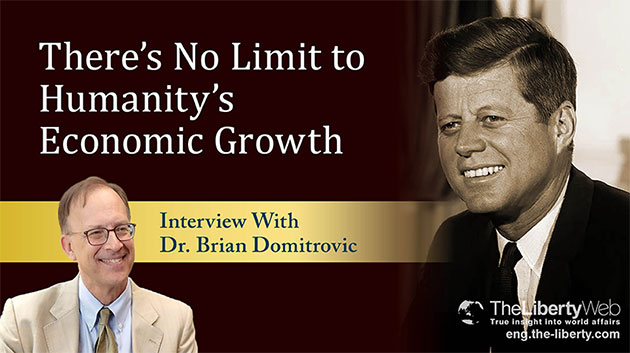
Following President John F. Kennedy’s term, one president after another dragged the world into recession. Dr. Brian Domitrovic walked The Liberty through the mistakes made in their policies, and shared the policies that will unleash economic growth.
Supply-Side Economic Historian Dr. Brian Domitrovic earned a bachelor’s degree in mathematics and history from Columbia University and a Ph.D. in history from Harvard University. He is the author of “Econoclasts” and co-author with Dr. Arthur B. Laffer of “Taxes Have Consequences.” He is also a columnist for the Forbes magazine.
Interviewer: Hanako Cho
Hanako Cho: In your book, you introduced Milton Friedman’s hypothesis that temporary tax cuts do not encourage people to spend money, but rather, people spend money based on their lifetime income. That’s crucial for the Japanese people because there are talks of implementing a temporary tax cut, not a long-term tax cut. To what extent do you think Friedman influenced Kennedy?
Dr. Brian Domitrovic: That’s another interesting question. I don’t know that John F. Kennedy cited or even read Friedman necessarily. I’m not sure, perhaps he did. Friedman was very active at that point.
I will say this, that Friedman’s permanent income hypothesis which he had made in the 1950s was talked about everywhere. It was a bitter blow against Keynesianism. I’m sure John F. Kennedy absorbed that lesson from the general culture.
So yes, Friedman, in an important respect, did pave the way for the Kennedy tax cuts because the permanent income was a thesis that the Keynesians had no counter to. The Keynesians had nothing to say about it. Friedman got them with that one, and I think Kennedy built on that weakness of Keynesianism to get his tax cut through.
A Temporary Tax Cut is the Worst Tax Cut
Dr. Domitrovic: I’m distressed to hear that Japan is talking about temporary tax cuts because if you want to have real business people make long-term plans, temporary tax cut is the worst kind of tax cut for them . If you want them to make an investment now and make money 10 years from now, that’s when you want the permanent tax cut.
Steve Jobs, Bill Gates, Jeff Bezos – they all think about the very long-term time horizon for their own enterprise, a time horizon of 20 or 30 years. They don’t want to think, “I’m going to [make an investment] now when there’s a temporary tax cut, and my business will get taxed once it succeeds and the tax rates are way up. That doesn’t make any sense.
Cho: Even the conservative party can make the wrong decisions when it comes to policy. How would you explain this?
Dr. Domitrovic: That’s a problem that has dogged all of American history. Certainly, the Republicans were opposed to the Kennedy tax cuts. The Republicans have not been good with maintaining the Reagan legacy, especially in the 2000s, that is, until Donald Trump.
Traditionally, the Republicans, with a balanced budget, were a part of two things: balanced budgets and tariffs. Before 1913, before the income tax of the United States, they were the tariff party. They were the tax party. It was the Democrats who were the anti-tariff, anti-tax party. They claimed, “We know how to balance our books, so give us the tax authority and the spending authority.” It is true that the Republicans cut taxes in the 1920s but that was the first time they had ever really done that.
Then, Herbert Hoover and Dwight Eisenhower came in and said, “We’re going to bring back the Republican Party to its proper principles,” which is balanced budget.
Cho: To them, it was a “return to normalcy.”
Dr. Domitrovic: Yep, return to normal. That’s a funny way of putting it. I like that. The return to normalcy was lowering the tax rates, but there were a lot of Republicans who were like, “No, normalcy is having high tax rates.” The Republicans in the 1880s and 1890s were the party of high taxes, high tariffs in particular.
Cho: Reagan emerged and changed that, right?
Dr. Domitrovic: Reagan was Governor of California from 1967 to 1975. He raised taxes. He raised tax rates at the top. It was only when he became president that he admitted he made a mistake, and that John F. Kennedy was right.
Cho: Maybe because of Dr. Laffer too.
Dr. Domitrovic: Dr. Laffer had a lot to do with it, and it’s also due to stagflation. The United States was running 10% to 14% inflation every year. And the economy wasn’t growing. You had to try something different, and so he said, “How about a tax rate cut?” and it worked.
Lyndon B. Johnson Had No Understanding of the Kennedy Tax Cut
Cho: During the Kennedy administration, Lyndon B. Johnson was the vice president. Why couldn’t he continue Kennedy’s tax cuts?
Dr. Domitrovic: That’s a transition that is so meaningful for American world history. Out of shock for Kennedy’s assassination, and in honor of Kennedy, there was an opportunity to implement Kennedy’s policies. The tax cuts were chosen for this purpose. Johnson got it through three months after Kennedy was killed, but he didn’t understand it at all. He had no understanding of [the tax cuts].
Johnson thought that the full effect of the tax cut would come in the first year in 1964. He thought it would get him reelected, and then after that, it didn’t matter. He raised tax rates.
He signed a 10% tax increase in 1968 to pay for the Great Society in the Vietnam War. He just never understood the tax cuts from the outset. He spent money like crazy, both foreign and domestic, and he raised tax rates and gave us stagflation.
Douglas Dillon was his treasury secretary for Johnson’s first year. He quit after one year. Johnson tried to get him back, and Dillon said, “Nope.” Johnson couldn’t attract good talent.
He had no understanding of the tax cut, and he raised tax rates and paved the way to the end of the gold standard. We got the 1970s stagflation because of it. Had he made a different decision, had he committed to the Kennedy legacy, the Democratic Party today would be the party of tax cuts.
Why Economics Didn’t ‘Click’ for Lyndon Johnson
Cho: As the vice president at the time, Lyndon B. Johnson directly saw the results and achievements made by John F. Kennedy’s tax cuts. Why couldn’t he understand the importance of these tax cuts?
Dr. Domitrovic: Lyndon Johnson was a very different man from John F. Kennedy. He grew up pretty poor. Journalist Robert Caro writes about how Lyndon Johnson grew up in a very poor region of Texas during the agricultural depression of the 1920s and the Great Depression of the 1930s. I don’t think he ever had a sense as a young man that the American economy could grow. He didn’t experience it personally. He experienced hard times and poverty when he was coming of age and growing up. I don’t think he had any sense of the possibility of the American economy to do great things.
Then he got into politics, in which he just completely ignored the economy and focused on politics. He wasn’t like John F. Kennedy who grew up in this really rich family of an entrepreneurial father who everything he touched, he changed, so that it would be useful. I don’t think Lyndon Johnson ever really had any sense that the American economy has incredible potential.
Cho: America experienced 5% of economic growth under the Kennedy tax cuts. Didn’t Lyndon Johnson feel the vibrant societies?
Dr. Domitrovic: Lyndon Johnson was so focused on politics. I literally want to claim that he didn’t even notice the economy. He was so focused on politics that he went, “The economy is producing a lot? Okay.” I think you had to get him pre-politics, maybe as a young man. In the 1920s, it was a difficult time agriculturally in Texas. If somehow, he had experienced a growing economy when he was young, he might have noticed, “Hey, the American economy can grow.” I don’t think it ever crossed his mind.
Cho: That’s why he focused on creating a so-called Great Society?
Dr. Domitrovic: Yeah. He knows there are rich people all over the place. He thought, “Okay, I’m going to take your money and give it to these poor people. We’ll just solve that problem.”
Richard Nixon Didn’t Believe in the Economic Potential of America
Cho: How much different was Richard Nixon who became the next president?
Dr. Domitrovic: Nixon is not so much different from Johnson. He grew up in California in his teens and 20s in a lower-middle class hustling family, but never had the experience of great success. He became a politician at a very young age in both Houses of Congress, and then as Vice President. He always observed that he never experienced economic prosperity himself, and complained how he doesn’t have enough money to buy good shoes and nice clothes and presents for his wife. This is after he’s been Vice President of the U.S. He was never able to afford it.
He knew that there were a lot of people out there who were making a lot of money, but it wasn’t him. He always reminded us that he’d never really experienced the American dream. I see the same kind of traits in Nixon. He wasn’t really gripped by the incredible potential of the country just to grow and to produce prosperity for many, many, many millions of people. I think that’s why his policies in the 60s and 70s were so consistent with stagflation.
Cho: Hadn’t he read any success from Kennedy’s tax cuts?
Dr. Domitrovic: John F. Kennedy defeated Richard Nixon in the election of 1960. Richard Nixon did not run on a tax cut in 1960 because that would be to defy Eisenhower, who Nixon served as Vice President under and was opposed to tax cuts. John F. Kennedy didn’t exactly run on a tax cut, but he immediately made it clear that was his policy. For Nixon to have supported the Kennedy tax cut in 1968 and thereafter, he would have had to say, “I endorse the policy of the man who beat me in 1960.”
Barry Goldwater, the Republican nominee of 1964, voted against the Kennedy tax cut in the Senate. The Republicans were opposed to the Kennedy policy. And Nixon had lost to Kennedy in the 1960 presidential election. So, he wasn’t going to cut taxes.
And the funny thing is, Nixon kept Johnson’s tax policy. He kept the income tax surcharge. He also kept the alternative minimum tax, which Johnson had suggested. So instead of accepting the Democratic tax cuts, he accepted the Democratic tax increases.
Cho: That’s not very conservative at all.
Dr. Domitrovic: Yeah, it’s just kind of a political status quo.
Cho: As a result, he had to enjoy an economic growth of 0.36%.
Dr. Domitrovic: Yeah, a very slow growth. The recession of 1969 was ridiculous. There had been eight straight years of 5% growth. Then all of a sudden, Nixon comes in, passes a tax increase, raised the capital gains tax rate by 10 points and instituted the alternative minimum tax. That just throws the economy into recession for two years.
Then, he goes off and abandons the gold standard which unleashes inflation of 8% to 10% a year.
Jude Wanniski Sees How Genius Arthur Laffer Is
Dr. Domitrovic: Another funny thing is that Arthur Laffer worked for him. Arthur Laffer was not counseling tax rates because he was still working on his economics, but he counseled, “Don’t go off the gold standard.” Whether to keep or abandon the gold standard was the big issue back then, and Arthur Laffer was totally clear about keeping the gold standard. Once the inflation got going, Arthur Laffer said, “Now we’re going to worry about taxes as well,” because real tax rates were going way up with inflation.
He started talking to Nixon’s officials. Arthur Laffer’s boss, George Shultz, at the Office of Management and Budget, then became the Secretary of the Treasury in 1972. Arthur Laffer kept consulting with him the whole time, and his successor under Nixon, William Simon. And that’s when Arthur Laffer starts saying, “Yeah, you have to cut taxes.” That was 1972 to 1974. At the time, during a dinner with Dick Cheney and Donald Rumsfeld who were members of the Ford administration, Arthur Laffer did the curve on a napkin for Cheney. Dick Cheney didn’t understand what he was saying, so then [Laffer] drew it on the napkin. The former WSJ journalist Jude Wanniski is the one who named the Laffer Curve and published the article in The Way the World Works. He’s the one who popularized the Laffer Curve. It was Jude Wanniski who pulled [Laffer] up and said, “You’re going to be relevant.”
Unfortunately, nothing happened until Jack Kemp produced Kemp-Roth in 1977 and Reagan passed it in 1981.
There’s No Limit to Economic Growth of Human Beings
Cho: Wow, it took a very long time. In your book, you wrote that the Democrat Party said Kennedy’s tax cuts weren’t applicable after the Kennedy era because they criticized there was no slack. How do you respond to this kind of criticism?
Dr. Domitrovic: Slack is a funny concept. It is very difficult to define.
At the time, stagflation was underway with a slowing economy and rising unemployment despite inflation. Yes, during inflation, goods become scarce and prices rise, so there is no surplus in the sense of leftover goods. Therefore, Keynesians believe that cutting taxes to boost demand would only drive prices up further. However, from a supply-side perspective, there is “slack” in the form of unemployed workers which is an untapped resource.
All the critics of Reaganomics, including George H.W. Bush said, “This economy doesn’t have any slack in 1980. Look at the inflation rate. It’s 14% per year. How can you say that we have unused resources when there’s 14% inflation?”
But can we really say there’s no slack in terms of unused resources? Think about that.
For example, Marc Andreessen in Silicon Valley argues that human growth is kind of limitless.
I’m very sympathetic to this argument. If economic growth is [about] human beings learning how to do better with their material environment, and we’ve already done a lot with our material environment, that means more and more work becomes not with the hands and the hard, fixed endowment of creation but with the head and getting along with people. What’s the limit to that? There’s no limit.
When you’re just talking about the hard earth, yes, there’s a limit. But as you master the hard earth, and economic growth all comes from the head and the heart, maybe there could be 20% growth per year. So, to me, the idea that there’s no slack is, “What are you talking about? There’s a lot of slack.”
The better we get at economic growth, the faster we should grow. We’ve conquered how to get our food, clothing and shelter. We can get much better at that, sure, while doing all these other things. [Economic] is leaping off. It’s kind of the old Aristotelian thing: you start at the bottom, your feet are on the ground; then as you get higher up in your faculties, you can do more and more things. That’s where we are in the economy right now.
This is a concept that’s well-respected in economics. Paul Romer won the Nobel Prize in economics and he argued, “As economic grow, they should grow faster.”
Big Government Destroys the Human Spirit
Cho: Wow, you’re so right. We tend not to think we can keep growing in that way because there’s limitation in our way of thinking. That is tragic in a sense.
Dr. Domitrovic: It’s tragic, yeah. I think big government destroys that kind of spirit, that kind of ambition, because nobody does anything in government jobs or in government contracts. The more private the economy is, the more people seize the opportunities that are right there before them.
That’s one of the reasons why I think shrinking government spending is so important. It makes people discover that they can take advantage of their own economic potential.
Not only do I think cutting tax rates is important, but I also like cutting spending because it frees up people to find themselves. They can find what the most profitable business is going to be.
Cho: This is my last question. How did you come to work at Dr. Laffer’s office?
Dr. Domitrovic: I first knew Arthur Laffer in 2007 when I was writing my first book, “Econoclasts,” the history of supply-side economics. I came to interview him. I interviewed everyone who was still alive, who was involved in the movement.
I came here and we hit it off. We enjoyed each other’s company. Then I published the book two years later, and he really liked it. We began working together, and then I came here to work with him full-time about six years ago. So, it’s been about 16 years that we’ve been working together, and I’ve been working full-time with him for the last six of those years.
A Shift From Academia to a Practical Realm: Getting Calls From Congressmen
Cho: That’s so fantastic that you’re devoting a life to this supply-side economics course. Give me your take on what it’s going to be like when you look back and leave this world one day.
Dr. Domitrovic: It’s funny you ask that, Hanako. Because when I first wrote “Econoclasts” in 2007, I was thinking completely different from what I think today. I was thinking that all the questions have been settled. Everyone knows that the Reagan Revolution worked and I’m just writing a history of it because no one has done that. And I’m thinking that people will read it in their leisure. When they get home from work or whatever they’re doing, they can open the book and read in their leisure time about how the great achievement was made.
Well, the book came out during the 2008 crisis. It came out in 2009, and I realized that this book is going to be about how to recover the Reagan Revolution. It’s not a matter of leisure. I’m not producing leisure goods; I’m producing things that people need in order to get back on track. I was shifted to a practical realm.
I had been an academic and I had really conceived myself as contributing to the leisure goods of the society. I had to shift to, “Now, I matter. I have the people consult me and all that.” The Speaker of the House of Representatives sent me a note, “You have to get here and tell us what to do.” And I’m like, “Okay.”
Since that time, I’ve had to concentrate on being relevant for policy solutions that we apply now, and we’re not applying them well. I would hope I get to see a restoration of the proper free-market, low-tax, sound money, American growth, world growth, that we all deserve and that we once had. That’s what I would like to see. Then, I could write books in leisure again about how we got there.
Cho: You’ll be very much needed.,
Dr. Domitrovic: That worries me because the more I’m needed, the more Arthur Laffer is needed.
It would be nice if we could go back to a situation in the 19th century, 100 years ago, where there were low taxes and sound money. Nobody ever talks about it. It would be great if we could get back to that, where we would become unnecessary.
That’s why I’m working to publish Reagan’s legacy in a documentary series.
We think that the supply-side revolution, or the Reagan Revolution, is not understood at all well. We would like to put together a documentary series that’s very well done on what the Reagan Economic Revolution really was. We expect within two years to have a very nice result. There’ll be an accompanying book that I’m writing.