From Tesla and Apple to Hypersonic Missiles: How China Is Stealing America’s Future
An Interview With David R. Shedd, Former Head of U.S. Intelligence
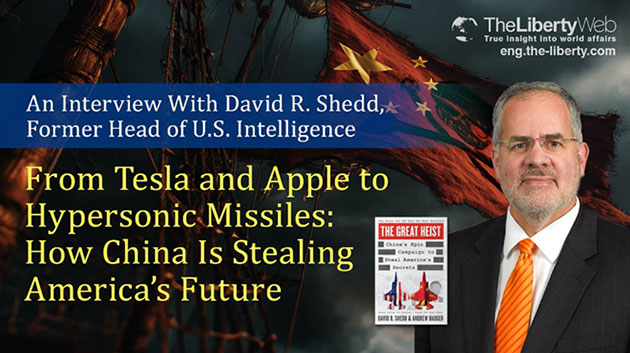
The Liberty spoke with a former acting director of the Defense Intelligence Agency and co-author of “The Great Heist: China’s Epic Campaign to Steal America’s Secrets” about the reality of intellectual property theft by Chinese Communist Party operatives and what is at stake for the United States, Japan and the free world.
(interviewer: Satoshi Nishihata)
David R. Shedd, Former Acting Director of the Defense Intelligence Agency
David R. Shedd has held a wide range of positions across U.S. intelligence agencies including the Central Intelligence Agency (CIA) for approximately 33 years. He served as chief of staff for the director of national intelligence, National Security Council senior director and as special assistant to the president for intelligence under the George W. Bush administration. In December 2025, he co-authored “The Great Heist: China’s Epic Campaign to Steal America’s Secrets” with former DIA case officer Andrew Badger.
Interview conducted on 3/7/2026
The Greatest Wealth Transfer in History
── In your book, you point out that since Xi Jinping took power in 2012, China has intensified its campaign of intellectual property theft. Could you explain how China’s rapid rise is largely attributable to what you call the “great heist,” and how the United States and Japan have suffered serious damage as a result?
David Shedd: I’m delighted to do this interview for The Liberty. I thank you for the opportunity to talk about “The Great Heist: China’s Epic Campaign to Steal America’s Secrets.” Much of what has occurred to the United States has also occurred, and is still occurring, to Japan and many other Western countries. It is a stunning example of what I believe to be, in all human history, the most unprecedented illicit transfer of wealth from one country – in this case the United States, and the West more broadly – to China. And this began not only under Xi Jinping, but several decades ago.
In June of 1984, the head of the Chinese Communist Party, Deng Xiaoping, gave a very important speech to a Japanese audience. In it, he spoke about the coexistence of a single-party state, the CCP, and what he called “managed capitalism.” His intent was that China would emerge from a “Century of Humiliation” as an agrarian, third-world economy and open itself to a controlled form of capitalism.
Tiananmen Square and the attacks on those who wish to seek their freedom occurs in June 1989, five years later. All throughout the 1990s, China began expropriating trade secrets. You had low-tech piracy of Japanese products and American products being replicated without a license. In other words, a fake Rolex, a fake apparel of clothing and all of that was beginning to occur very widely. All the while, China was moving, with the support of the West, toward joining the World Trade Organization which it did in December of 2001. That moment ushered in the next two and a half decades of this unprecedented transfer of intellectual property for the Chinese.
When I say “Chinese,” I mean the CCP: a party of some 80 to 90 million members out of 1.4 billion people who have been acquiring and applying this intellectual property to bypass research and development in Japan and the United States. Think of it this way: imagine obtaining all the blueprints for an electric vehicle, or the research & development for next-generation pharmaceuticals. That is what has been happening.
During the 2000s, when I sat in the White House and the National Security Council, America’s focus was largely on the global war on terror after 9/11. China, however, kept moving along in this illicit transfer of wealth, all the while ushering in the era of Xi Jinping in 2012. He consolidated power in 2013, and immediately he really started to leave his mark. He launched his “Made in China 2025” plan in 2015, which effectively served as an intelligence requirements list for China on those things they must succeed at that would include: aerospace, microelectronics, biotech, artificial intelligence, quantum technology.
That plan was married together with the growth of the Ministry of State Security from an estimated 150,000 operatives to 300,000 operatives under Xi Jinping’s increasingly authoritarianism rule. A very large increase of intelligence and security capabilities by the Chinese to acquire this knowledge was illicitly acquired. Why is this so important? The argument my co-author Andrew Badger and I make in “The Great Heist” is that China’s GDP grew from roughly $1.3 trillion in 2001, when it joined the World Trade Organization, to approximately $20 trillion today. They could not have accomplished that without stealing Japanese and American trade secrets. This is about epic levels of economic espionage. The book centers on that. During that period of time, they bypassed the investments in research and development. They took cutting-edge innovation from the West, from Japan, and the United States and applied it for the modernization of the People’s Liberation Army and capabilities. It’s a quantum leap economically for China that could not have been accomplished without taking our trade secrets, our manufacturing secrets, our economic secrets, and applying it to them.
Made in China 2025: A Scorecard
── Thank you. Do you think Made in China 2025 has been successful?
Shedd: By the Chinese’ own definition, it has publicly announced to being a big success. It only managed to fail in two places out of ten priorities: aerospace and biotechnology. China remains behind the West in both of those. In all other areas like green energy, electric vehicles, and more, it has succeeded. BYD now leads Tesla by orders of magnitude in the EV market. The EV market is now dominated by Chinese vehicles in part because of what they did to Elon Musk and some others. And I might add here that Xi Jinping has extended that plan to 2030. The plan is still active.
The Tesla Heist
── You say in your book that every aspect of American innovation is being targeted by the CCP. As an example, you mention that Tesla’s source code for autonomous driving was stolen by Chinese spies. Could you explain that incident and share your perspective on it?
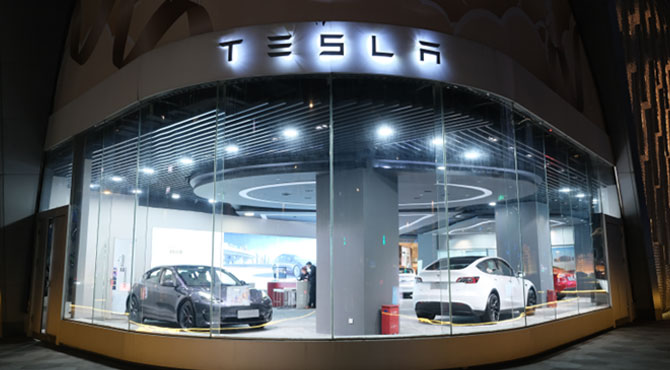
Shedd: Elon Musk, the CEO and President of Tesla, traveled to Shanghai in the summer of 2018 and reached a high-level agreement with the Chinese Communist Party for a solely owned Tesla China. This is very unusual to have been given a special arrangement in which it didn’t have to be a joint venture, 51% Chinese owned, 49% foreign, which is the standard. Elon Musk got sole ownership of Tesla China.
In January 2019, just five or six months after signing those agreements with China and two days before breaking ground for the Gigafactory in Shanghai, which is the end-to-end production for Teslas, Mr. Cao uploaded a billion dollars’ worth of source code for Tesla’s autopilot system. He was an employee of Tesla in the United States. This was truly a monumental heist, the robbery, the larceny of the source code, which is now embedded in every Chinese electric vehicle as a result of that. The story here is that Mr. Musk thought he could always stay ahead of the Chinese. Today, the comparison between Tesla sales and BYD speaks for itself.
The story of Tesla encapsulates how China operates: while reaching an agreement that you would think would be binding, they have an agent of their own taking out the source code for the driverless autopilot vehicle.
Robert – stock.adobe.com
Apple, Google and the Scope of Economic Espionage
── Your book also addresses Apple and Google. Could you elaborate on those incidents?
Shedd: The Apple story is stunning because it even involved an interview with the [former] CEO Tim Cook. In 2018, an Apple employee Xiaolang Zhang who had signed all the nondisclosure agreements downloaded the full schematics, designs and source code for what was known internally as Project Titan: Apple’s classified program for a driverless car, reporting directly to Tim Cook. Mr. Zhang left Apple and joined a Chinese EV company, X Motor, where those designs were put to use.
Tim Cook has stated that this cost Apple billions of dollars in lost business opportunity – the car had not yet been built; this was a vision of Apple – and in his estimation, cost the United States 100,000 jobs. Apple was ultimately forced to cancel its driverless car program entirely.
The Google case is quite different. Linwei Ding was convicted in January of this year on seven counts of economic espionage. In 2019, he uploaded designs related to supercomputing, specifically the coding and graphics processing units for managing the sophisticated microchips Google was developing for large language models in AI.
In the heist, Mr. Ding does something very differently than what we saw with Mr. Zhang. He goes to China and sells those designs. But he also opens up his own company. The story of Mr. Ding is that of old fashioned greed; his motivations do not appear to be ideological.
── How did Tim Cook respond after the Apple incident?
Shedd: It caused him to revisit the value of having Apple phones and other things produced in China. And now you see a decided shift toward India. Why? I did not talk to him about this, but he has expressed profound disappointment to the FBI as to what happened, but also, he has perhaps concluded that he cannot trust the Chinese. And of course, Huawei and ZTE remain big competitors to Apple. I have no doubt that the Chinese pass everything they can to those companies.
Mojahid Mottakin – stock.adobe.com
Hypersonic Missiles and the War Before the War
── Could you explain the connection between Chinese spy activities in the Philippines and China’s rapid development of hypersonic missiles? And what do you make of the idea that the outcome of the next great-power war won’t be decided solely on the battlefield, but by scientific breakthroughs and strategic intelligence collection that happen before the shooting starts?
Shedd: You’ve embedded two separate questions. They’re related so I will take them in the order that you presented it. The connection between those spy activities in the Philippines and China’s hypersonics program leads directly to a remarkable moment: in August of 2021, China conducted a hypersonic test in which a vehicle went orbital and landed within the area of a soccer field. For readership, a hypersonic vehicle travels at Mach 5 or greater and can carry a nuclear-capable warhead. The Pentagon itself admitted it did not know how China was able to achieve this. That should alarm everyone – especially Japan and the United States – because hypersonic vehicles can evade radar detection at those speeds. People need to understand the significance of the hypersonic vehicle.
What was happening near that U.S. base in the Philippines was signals intelligence collection around American hypersonics testing – not a vehicle itself, but the related capabilities. Meanwhile, at Los Alamos National Laboratory in New Mexico, near Santa Fe, dozens of Chinese scientists had co-researched wind tunnel effects related to hypersonics: materials behavior at extreme speeds, heat resistance, aerodynamic drag. They didn’t walk out with a hypersonic vehicle. They walked out with the knowledge. That knowledge, combined with the signals collected in the Philippines, fed directly into China’s August 2021 test.
That is why the second half of your question is so important. Consider denial-of-service attacks that could disable communications, GPS, radar systems. Imagine none of that working on the day a conflict begins. That’s why these scientific breakthroughs in your question may result in what we call “zero-day.” That’s the day you’re going to start kinetic action of denying the capabilities of your adversary, which could be Japan or United States in the case of China. If Xi Jinping holds to his stated 2027 timeline regarding taking over Taiwan – and I’m not saying he will act, but that is his stated intention – the stolen technology and capabilities from the United States, Japan, and the West could give China a decisive advantage before a single missile is ever fired.
── Do you think China is now the number one country in the hypersonic area?
Shedd: I do. China is unquestionably, in my mind, the most advanced in hypersonics today. And the implications are serious. A hypersonic vehicle with a nuclear, chemical, or even conventional warhead is an order of magnitude more dangerous than the ballistic missiles Iran has been firing across the region. Those Iranian missiles are not hypersonic and they have still posed a significant challenge to intercept. That’s the difference.
Faith, Mission, and the Battle Between Good and Evil
── You have described Communist China as an adversary, not a competitor, and you have been sounding serious warnings about the CCP and Xi Jinping. I think it’s very courageous and I believe your activities are based on faith in God and a sense of religious missions. You were raised as the son of missionaries. Could you share how your faith informs these convictions?
Shedd: Well, thank you for the question because I’m always very open and willing to talking about my faith. I was raised as the son of missionaries in Bolivia, Chile, and Uruguay, where I finished my high school years. I was just recently on a missions trip in the Amazon in Brazil. Our time on this earth is limited for all of us, regardless of how long we’re able to live, or how long God gives us breath to live.
I believe very strongly in the sense of a calling, a dedication to something larger than oneself. And I think this is often missing in younger people. Most things worth doing take time to do. I’m turning 67 this year, and the North Star throughout my life has always been my faith, the conviction that there is something beyond this world and that there is a battle between good and evil in the world.
I joined the national security community in 1982, coming out of Geneva College and then Georgetown University, to promote the good values of the United States – the same values that defined its posture against the Soviet Union for 70 years. I felt very strongly that fighting communism was a valid motivation because communism suppresses. Communism downgrades human beings to not having choice. They don’t want people to have freedom. They don’t want people to speak with a voice that can be heard. In Xi Jinping’s China, your loyalty is to the party and not to a higher calling of a higher sense of order, which is, of course, in a sovereign God in terms of my view. So, this was an enormous motivation for me. That’s the center of my life.
I also take it very personally the fact that the Chinese stole my personal dossier – along with 22.5 million others – in the 2015 Office of Personnel Management breach. They have no right to that data. And so I am highly motivated to tell this story. This book is, in a sense, symbolic of the digital twin of the F-35 to the FC-31, which is an exact copy, all of it stolen from us. If there is ever a war with China, I do not want the technology we developed used against us, against Japan, against South Korea, against Australia. That is why I feel so strongly in this embracing of my faith and worldview, which God is preeminent, is absolutely critical to what I do.
── It sounds as though you believe God has given you a mission to fight.
Shedd: I have no doubt that he has given me a mission, and it will last as long as he has me here. I am committed to serving God above all else.
People who deny evil are, if you’ll pardon the expression, handicapping themselves as a golfer might do. Of course there is evil. Kim Jong-un is evil. Communism is evil because it suppresses everything from human rights to freedom of expression and personal liberty. It does not want you to worship anything but the state and the party. Civil-military fusion in China is total [evil] – there is no separation. You do not have a private life in China that is separate from the state and the party. And communism is absolutely atheism because their god is the party. That goes back to Lenin, back to Stalin. It’s absolutely abhorrent. This is really important for a magazine called The Liberty. Communism cannot allow liberty because liberty will challenge the party.

The Future of the CCP and Trump’s Strategy
── Many people wonder whether the CCP can survive its economic challenges. What is your view of its future?
Shedd: Samuel Huntington, under whom studied during my Master’s academic work, offered a useful characterization: authoritarian and totalitarian regimes are brittle. They break easily, but they’re very resilient and can be effective in pushing back against challenges to them. You are seeing that with the authoritarianism and totalitarianism in Tehran today. The CCP will fight back against any threat to its authority, because power must be absolute in their hands.
I don’t deny that China has lots of economic issues: a housing bubble, demographic pressures from the one-child policy, and slowing growth rates. By the way, the one-child policy emerged out of a godless definition of life, and the countless abortion of girls associated with the one-child policy because boys were preferred, is stemming from a very godless view of the world. Yet I do not think the CCP is in danger of falling. They have more control over their citizens today than ever before. They can track people. Their entire system is designed to suppress dissent, and they do it ruthlessly. Anyone who doesn’t think Tiananmen Square could happen again is wrong. It will happen again if there’s ever an uprising of the like of 1989. I have no doubt. Look what happened under Covid with Xi Jinping. He closed down entire cities.
── President Trump has been maintaining pressure on Venezuela, Iran, and Cuba, all of which have close ties to China. Do you see his foreign policy as a strategy to counter China?
Shedd: I would frame it slightly differently. Look at China’s actual behavior, not its foreign ministry rhetoric, which is just noise. China has taken no meaningful action to support Iran because it needs the Strait of Hormuz open for the oil. Iran supplies China with approximately 1.4 million barrels of light crude oil it processes daily. Venezuela’s PDVSA was sending 500,000 to 600,000 barrels of heavy crude oil to China per day from a very tired, aging production base. Cuba, meanwhile, has not given China oil but an intelligence platform: a signals and intelligence collection base 90 miles from South Florida.
There is also a military component. China’s ties to Iran and by extension, Russia as well, include access to very high-end drone technology. That will be shut down. So, there is an indirect, very real impact on China.
I have a prediction for you. I think the elections in Brazil in October will go back to a Bolsonaro-like government and Lula will lose. I believe that in Colombia, which has elections in May, the center-right will win over the center-left. So, you have a sweep of center-right governments in Latin America that will start to push back on China.
The summit President Trump held at Doral, in Miami, was designed to reinforce mutual security for the Western Hemisphere tied to the United States, not China. With the presidents of Chile, Ecuador, Panama, and others present alongside Trump, that was an important message that the security in the region is really American security and not Chinese security.