The Power of CCP’s Propaganda: Insights from a Former Indian Senior Diplomat Who Witnessed Tiananmen Square
An Interview with Mr. Jayadeva Ranade
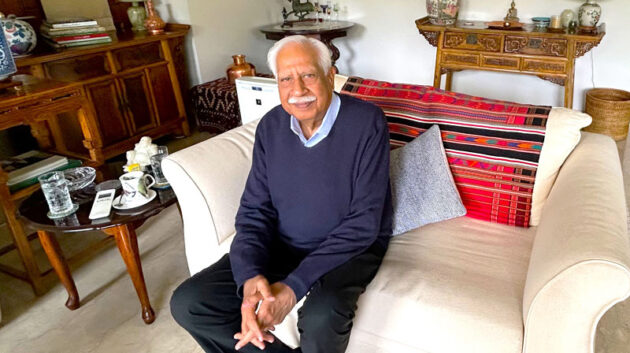
Amid growing global turbulence, as India’s presence on the international stage continues to rise, The Liberty spoke with Mr. Jayadeva Ranade, an Indian former diplomat specializing in China analysis. He has long warned of the threat posed by the Chinese Communist Party (CCP) and has strongly advocated the importance of building a strategic framework to counter China.
Jayadeva Ranade
(profile)
Jayadeva Ranade is a former Additional Secretary in the Cabinet Secretariat, Government of India, and he is a former Member of the National Security Advisory Board (NASB), as well as a former Minister in the Indian Embassy in Washington. He is now the President of Centre for China Analysis and Strategy. He is also the author of “China Unveiled: Insights into Chinese Strategic Thinking” (2013); “Cadres of Tibet” (2018) and “Xi Jinping’s China” (2018), and the co-author and editor of “Strategic Challenges India in 2030” (2020).
(Interviewer: Mayuko Kataoka)
Interviewer: During the Tiananmen Square Massacre on June 4, 1989, you were stationed in Beijing as a diplomat. You witnessed the shocking events firsthand and even attempted to persuade student leaders protesting against the CCP, warning them: “Leave the square before the government moves in. There is no guarantee of your life.”
In addition to such experiences, you have continuously gathered and analyzed Chinese-language information. Even in the 1980s, when concern within India’s Ministry of External Affairs about CCP expansionism was not yet strong, you pointed out the dangers of the one-party authoritarian system.
You later served as a member of the National Security Advisory Board (NSAB), an advisory body to India’s National Security Council, and after retirement, you established India’s first think tank dedicated specifically to China. Through research, publications, and contributions to major newspapers, you have continued to support India’s national security.
Where did your deep insight into the CCP leadership—well ahead of its time—come from?
Mr. Ranade: Essentially, I was studying China.
A lot of what they feel or what their plans are is discussed in their newspapers. If you reads their newspapers carefully, I think you get clues.
It is not in the form of one essay or one speech. But you find small fragments across different papers.
For example, when they talk about trade or maritime trade, there would be a sentence like:
“Why is the Indian Ocean called the Indian Ocean? It is not India’s ocean.”
Then somewhere else, maybe a few months later, there would be another statement saying:
“Just because it is called the Indian Ocean does not mean it is India’s ocean.”
The same logic was used when they claimed the South China Sea. They said it is called the South China Sea, so it is China’s sea.
Another example, which is slightly different but in a way similar, is the way they now claim that Buddhism is an ancient Chinese religion.
But it is not a “Chinese religion.” And no one person can claim it.
As Buddhism spread to different places, it absorbed local cultures and changed to some extent, but the basic philosophy remained the same.
The Buddha laid down the principles, and his disciples spread them—one stream went to Southeast Asia, another went north. Two different streams.
The northern stream reached China, Korea, and Japan, and it changed a little along the way.
But when you see the CCP’s argument, you get the feeling that they are not saying it is an ancient Chinese religion because they believe it, but because they want to claim it.
It is a way of exercising influence or domination over those who follow it.
You do not see this elsewhere—not in Thailand, not in Japan, not in Korea. Only in China.
Why it happened is another issue, but perhaps it comes from a feeling that they once dominated this entire region.
So this is how I picked up their thinking, their views.
Whenever you read documents or newspapers or anything coming out of China, you find fragments of the same logic. You pick up these fragments, and over time, like a puzzle, you put them together and a picture emerges — a kind of dominant logic underlying it all.
That is my understanding.
Mao Zedong’s Tributary World View in ‘On Contradiction,’ Written Before the Fall of Beijing
Interviewer: It sounds very difficult, because that kind of understanding requires insight. Usually, leaders do not openly state their intentions, such as “we want to dominate the world.” They do not put it in one essay.
But, you find it in pieces—one sentence here, something there. That kind of understanding is at the heart of diplomacy.
Mr. Ranade: Also, they follow a certain line of thinking.
For example, Mao Zedong framed communism in the Chinese context. Chinese Communism, so to speak.
He wrote essays that are worth reading. For instance, in “On Contradictions,” written before they captured Beijing, he wrote that China would become the sole security guarantor for Asia. We have to understand what that meant. To my mind, the meaning was that China would be the power.
If you look at the old tributary system, others must look to China for protection, etc.
Whereas Indian leaders at that time believed that the world is large enough for everyone to have a role.
So there is a difference, a huge difference.
It should be Japan as well. Japan and India—India and Japan—have common ground. We do not aim to dominate this world.
Interviewer: It must have been very difficult to grasp the intentions of the CCP at that time.
Mr. Ranade: At that time, China was not very powerful, didn’t have much economic power. They didn’t have much military power either. So, many people did not accept this view. They thought we were exaggerating or fabricating a threat.
But as China became stronger, we began to see that it was becoming more dominant.
Interviewer: From a security perspective, China’s expansionism is dangerous, and Japan and India share this concern.
However, beyond security, your concern about totalitarianism seems to be based on a deeper political philosophy—that human beings are sacred, like children of God or beings with Buddha nature.
Mr. Ranade: One cannot advise others on what they should do.
But certainly. I think China’s approach is that the state comes first.
Of course, in times of war or under pressure, that may be understandable. But normally, the individual’s well-being should come first.
I think China focus on the common good, everyone’s good, the collective good, rather than just one person.
But in the process, they’re not paying attention to the individual, the one man.
It also means that if you’re strong enough, if you make enough noise, then people listen to you.
I remember, many years ago, when I was at Harvard University. After a lecture, we were discussing democracy and the Chinese system.
A young Chinese man raised his hand and said:“It is debatable whether democracy or communism is better.”
Then he said:
“In China, if there is no food in a region and people are starving, the state will not respond if people cannot make noise. Even if they protest, it will be suppressed. But in India, people raise their voices, others join in, and the government responds.”
That is the fundamental difference. So, it comes down to the strength of one voice.
The Three Gorges Dam: A Project That Forced Mass Relocation
Interviewer: At The Liberty magazine, we have consistently interviewed Chinese human rights activists (Having covered numerous cases of horrific persecution of ethnic minorities in Xinjiang and Tibet as well).
Some of them have shared very severe situations. Under the Chinese Communist Party, especially during the Xi Jinping administration, there have been cases where entire villages were destroyed and people were forced to relocate in order to make way for large-scale development projects.
Mr. Ranade: Yes. The planners and leadership are thinking in terms of modernization and development, which are also important.
But for ordinary people, they may have built their own houses and invested a great deal in their land. They have lived there for many years, so naturally they may not want to move.
However, when the state makes a plan, it is carried out like a clinical operation. The emotional aspect is not taken into account, and entire villages are simply removed.
For example, when they were building the Three Gorges Dam, the whole area was flooded. So the people were removed; they were told that they had to find another place. So that is a kind of perpetual conflict, I think.
But the government cannot simply ignore people’s lives and make unilateral decisions. People’s views have to be considered. Alternatives must be provided, and there has to be some form of negotiation before implementation.
For example, in a country like Japan, the government cannot simply tell people, “You can no longer live here.” That kind of approach would not work.
For the CCP, Any Form of Organization Is Seen as a “Challenge”
Interviewer: We have also conducted many interviews regarding religious persecution.
Mr. Ranade: Yes, it is essentially the same issue.
The state—in reality, the Chinese Communist Party, which forms the government under a one-party system—cannot or will not allow any challenge to itself.
The Party now has close to 100 million members, 98 million.
Any group or organization that gathers and acts in an organized manner is seen as a challenge to the Party.
Take Falun Gong, for example. I think, Falun Gong made a mistake by suddenly appearing in very large numbers at Tiananmen Square soon after the Tiananmen incident. Following that, the Chinese Communist Party moved to suppress them.
The same applies to churches.
China has what is called the “Three-Self Patriotic Movement.” Islam, Christianity, and Buddhism all exist in China, but they are all controlled through this system.
The CCP says they appoint monks, priest, and religious leader, and determine what should or should not be taught.
So a question always arises.
The Chinese Communist Party supposed to be atheist—so how do they understand these religions, and what exactly are they trying to teach through them? There is an inherent contradiction.
However, for the Party, the issue is not religion or scripture itself.
What they are concerned about is any group getting organized.
Any form of organization is seen as a potential challenge to the Chinese Communist Party, and that is why they crack down on any group.
Interviewer: Originally, religion is meant to build ethics, promote compassion and love, overcome hatred, and encourage forgiveness.
It is meant to guide people to live harmoniously while respecting one another.
However, under a system where religions are not allowed to organize freely, how can people share common ground—universal values—and live harmoniously?
Mr. Ranade: It is difficult.
There are two or three issues, I think.
The first one is, the Chinese feel that they are powerful, large, and strong. Now they also say that historically they have always been a great power, a great people. So for countries like Japan and Korea, that becomes a problem.
The second one is, they try to impose their culture and their thinking. For example, Confucianism. They say, “This is what Confucius said, so you must accept it.”
And as I mentioned earlier, they are now trying to usurp Buddhism as well. So that will be the next thing. Buddhism may also come under their control.
These are ways of dominating without using military force.
Later, military force may come, but for now, this is what they are doing.
So this will be a challenge for all of us.
Until the Chinese people realize that the current system under the Chinese Communist Party is not good for them, things will not change.
Until then, it will be very difficult, I think. The CCP has a complete grip. They have strong military power and strong internal security power.
The Power of Propaganda:
Student Indoctrinated by CCP Ideology at Indian Universities
Interviewer: Thank you. As human beings, we are created as sacred beings—like children of God—we naturally tend to move toward goodness and to look within ourselves. We ask questions like “Who are we?”
These questions eventually lead us to enlightenment and compassion, the ultimate goals.
But if we are prevented from pursuing this path, from deepening and refining our nature, it leads to unhappiness.
Mr. Ranade: Yes, that is correct. You can see it anywhere. In China as well, despite all these controls, protests still happen.
I am not saying protests do not happen in the most advanced or civilized societies. But in these societies, people have outlet, and in China, there is no outlet.
Interviewer: As you mentioned, until Chinese people realize that the CCP’s worldview does not lead to happiness, China may not change. This is very insightful.
Mr. Ranade: I think what you mentioned was at a higher level of consciousness. But before that, people will begin to notice differences.
They begin to notice the gap between themselves and the privileges enjoyed by the leadership. They already see them, but they cannot do anything.
When they start realizing that this gap can be changed, then some movement may emerge. That will come. It may take time.
But Chinese people have started traveling abroad. When they go abroad, they see how different societies are. They return. Maybe they can do something, maybe they cannot. But the thought remains that the world is not only China.
At first, they may be impressed by China’s infrastructure, large buildings, and propaganda. But when they go out and see other societies, they realize that things are different. That change may begin gradually.
I had a researcher working with me. He came from a university that was heavily influenced by Chinese and leftist thinking.
Throughout his university life, he heard only one narrative:
“China is the greatest,”
“The Chinese system is the best,”
“The Chinese government is the best,”
“There is equality.”
He had never been to China, but he believed it. Then he joined me.
In discussions, he would always defend the Chinese system. So when I went abroad, I took him with me.
First, we went to Taiwan. He saw the situation there.
I asked him, “These are the Han Chinese (in mainland China), and those are the Han Chinese(in Taiwan)—yet they are different.”
He tried to explain why they were different. Then we went to mainland China. He saw that as well, but his views still did not change.
Then, after one or two years, we went to Paris. There, his eyes opened.
He said, “Now I understand.” “This is a completely different world.”
That would show us how strong propaganda can be. You can imagine that the Chinese people have been exposed to only one message—the only message they receive.
Targeted Sanctions on CCP Officials Are More Effective
Interviewer: If high-ranking officials within the CCP realize that the one-party system does not work, how could they shift the country toward freedom?
Mr. Ranade: I do not think they would want to. They are the privileged class.
If you include current and former Party members and their families, nearly 280 million people benefit from the system. Even now, they receive special privileges.
They get special supplies and benefits that others do not. During festivals, Party cadres visit retired officials, give them gifts, and maintain relationships. So they feel that even if the system is not good overall, it is good for them.
Change is unlikely to come from within the Party.
There will be internal differences—one person may oppose another—but that remains within the Party. They do not want outsiders to come in.
So when change happens, it may be somewhat chaotic—almost like a breakdown.
That is why I used to tell people—especially many Americans who talked about applying pressure through sanctions—that broad-based sanctions are not going to work.
In China, they will identify areas that are important to them and allocate people and resources to deal with the pressure. So sanctions may delay things, but they will not stop them. After five or seven years, they will recover and continue.
Instead, what I suggested was targeted sanctions.
Sanctions that directly affect members of the Chinese Communist Party. Many of their children study in the West. If you apply sanctions individually, within 24 to 48 hours, those children would have to return.
That would hurt them directly. They would lose access to top education, and the funds they have kept abroad for education and travel would be affected.
That would create real pressure.
Then they might tell Xi Jinping, “This is enough—change the policy.” There were already voices within the Party saying not to push relations with the United States too far. But nothing changed.
Instead, when Xi Jinping leveraged China’s dominance in rare earths and other areas to apply pressure, his confidence increased.
Interviewer: Even Xi Jinping’s daughter studied at Harvard and later returned to support him.
Mr. Ranade: So the focus should be on the interests of the Party members themselves.
From Land Defense to a Dual Focus:
India’s Growing Maritime Strategy Over the Last Decade
Interviewer: Thank you for your insights on external pressure. Now, regarding concrete strategies, I would like to ask about maritime security.
In “Strategic Challenges India in 2030,” which you co-authored, it is noted that India’s need to manage borders with a number of countries has led it to historically focus on land-based security, and maritime strategy has not been a top priority. Are there ongoing discussions in India about maritime security strategies?
Mr. Ranade: Yes, there is a lot of discussion. In fact, it has become a major focus.
India has a very long coastline, and most of our trade depends on sea routes. Japan is dependent on maritime trade, India is, and China is as well.
The concern is the rapid expansion of China’s navy.
The question people ask is:
If you are not intending to threaten anyone, why do you need such a powerful navy?
China says it is for protecting its sea lanes. But no one has threatened them at sea. So naturally, people become cautious.
Another issue is how China is increasingly dominating the South China Sea. They are also developing ports across different regions. That creates concern.
Interviewer: This links back to what you mentioned earlier — the claim in the Chinese press that “the South China Sea is China’s sea.”
Mr. Ranade: We are discussing these issues with Japan and other countries. The Indian Ocean is a large and strategically important region. India is well positioned geographically, and we have historically had one of the largest navies.
France and the United States are also watching closely. Countries like the UK, they are geographically distant, but also do not want China to dominate the region. Because sea lanes would be affected.
No one wants a single power to control the oceans. That is the current situation.
Interviewer: Unlike Japan, an island nation, India borders a number of countries, making it challenging to manage multiple fronts at once. Has there been any shift in discussions around maritime strategy, including budget allocation and how much emphasis is being placed on concrete capability building?
Mr. Ranade: Yes. In the past, India focused more on land security. But over the last ten years, that has changed. There is now much more focus on maritime security.
We have started building more warships and strengthening our navy. It is expensive, but necessary. We must address both land and sea security. Ultimately, how much we invest depends on how aggressive China becomes.
Leadership: Wishing and Encouraging the Growth of Others as Equals
Interviewer: To close, I would like to revisit your view of humanity and political philosophy. How was your philosophy shaped?
Mr. Ranade: There was no formal or conscious education that shaped it. It developed naturally as I grew up. It came from what I saw at home and the values I received from my parents.
My father was very strict and had clear views about what is right and what is wrong. We absorbed a lot from him. My mother, like many mothers, was more gentle. We were not forced into anything.
We were simply taught how to behave properly. Beyond that, we had freedom. If we wanted to do something, that was fine. If not, that was also fine.
As you know, Hinduism is not dogmatic. It allows for many perspectives and diversity. So I grew up in that kind of environment.
There was also a sense of responsibility toward the country. We wanted the country to grow stronger—especially economically. Military strength is important, but economic strength is even more important.
Improving people’s living standards was always a key concern.
As individuals, we were taught not to be corrupt, to be tolerant, and to allow others to pursue their own way of life. Tolerance is the right word.
But sometimes, you can also gently guide or advise others.
Interviewer: It seems that you have lived by the principle of ‘Noblesse oblige’ — the idea that privilege comes with responsibility.
Mr. Ranade: For example, if I am at an airport and finish a cup of coffee, I look for a place to throw it away. Sometimes a young person nearby will say, “Sir, I will throw it away for you.”
It is a very nice gesture. This used to be common, but in the last twenty years, it has become less so. So I always thank the person. I say, “Thank you very much. You’ve been brought up well; you’ve learned well.”
Something along those lines. I say this in the hope that such words will encourage him to continue behaving this way in the future. These may seem like small things, but you simply let people be and grow in their own way.
If people misbehave, of course, one has to say something. At least, I make a point of saying something. Otherwise, you just let them be.
Many of them have not been abroad. Many of them have not been educated. Many of them have not seen the kind of life that we have seen. So their manners and all are a bit crude.
These are small things in which we can help our own people to grow.
Interviewer: Especially in a country like India, where there is great diversity in language and culture, understanding others with empathy seems important—not from a superior position, but as equals.
Mr. Ranade: Yes, that is correct.
The moment you speak down to someone, it does not work. But if you speak as an equal, it carries more weight.
Interviewer: That sounds like true leadership. I believe our readers will love your insight and your view of humanity. Thank you for this precious opportunity.