People Are Moved by Words Spoken From the Heart
World Teacher’s Message No.322

I believe that in missionary work, words are our tools. In the scripture “To Become a Chosen One”(*), it teaches that “truth resides even in simple words.” I am not good at speaking, and I can only express the words of truth in my own way – will truth still dwell in such words? Please teach me how truth can reside in words.
From the Q&A session of the lecture “Natural Disasters and Man-Made Disasters,” Happy Science Fukushima Branch Temple, June 4, 2011
(*) Published by Happy Science
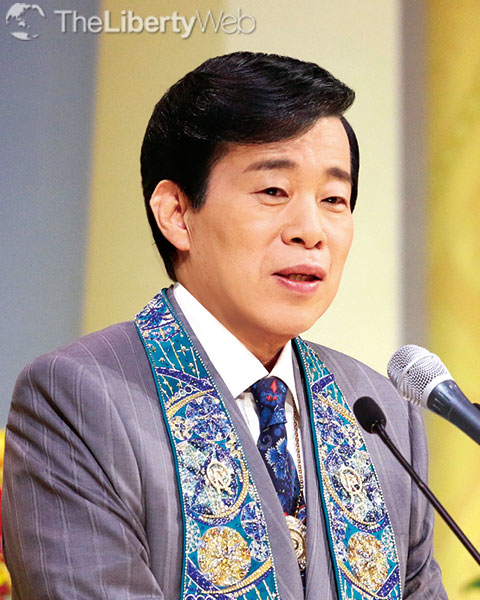
People often think things like, “Unless you’re a professional speaker, you can’t give a good talk,” or “Unless you’re a schoolteacher, you can’t give a proper lecture-style talk,” or “Unless you’re a professional writer or someone who makes money from writing, you can’t write something worthwhile.” It’s fine to think that way, of course.
But professionalism is not the only reason why people are moved.
Sure, I understand that there’s a certain level of skill involved in doing things professionally. But when it comes to spreading the truth, it’s not about being a professional. It’s something universal that transcends all professions. When it involves touching the lives of many people, it’s the sincerity of your words that moves them deeply.
Right now, our organization encourages followers to study English quite a bit. But if you are only allowed to speak English, there’s no way to compete and win against native speakers, such as those from the US or UK. Even if you’re told to “speak like them,” it’s simply not possible.
But I went to the Philippines and delivered a lecture in English without a script in front of an audience of around 6,000 people. To my surprise, over 90% of the first-time attendees became believers.

“Love and Spiritual Power” was given in English at the Inares Center in the Philippines.
Even if the Catholic Pope came to visit, something like this wouldn’t happen. Over ninety percent of non-believers wouldn’t suddenly become believers. I don’t think it’s simply a matter of how good someone is at English or not. I believe it comes down to how much truth is contained in the words being spoken.
It’s about how much truth and emotion are put into what is being said. That’s what really resonates with people – not how the sentences are constructed or whether the grammar is correct.
This example happens to be in English because the audience understands English, but when I gave a lecture in Brazil – particularly the final one there – some Brazilians said, “We understand Japanese better than English,” so I gave the lecture in Japanese with simultaneous interpretation into Portuguese.
I believe most of the audience listened through the interpretation, but even if they didn’t understand the words themselves, my emotions – my passion – came through. Even if they could only get the meaning through the interpreter, the way I spoke and the feeling behind it pierced their hearts. That’s why I believe I was able to move them deeply.
To Convey the Truth Frankly
That’s why I think that being overly concerned with the accuracy of words or with how others might perceive you is, in a way, a form of self-preservation. Rather than that, I feel it’s more important to adopt an attitude of frankly and honestly expressing the truth.
In that sense, I think that people from the Tohoku region, located in the northern part of Japan’s mainland – who are often not very talkative – might actually be better at conveying the truth. They don’t say unnecessary things. They speak sincerely and seriously, and when they say the truth plainly, it can actually have a powerful impact. So, in the end, even if you’re speaking in a foreign language, you can often get your point across with just a few words. That’s why, when we talk about “language,” what comes before the words is really what matters – it’s what lies in your heart. Your thoughts, your feelings – what’s inside you – that’s what’s truly important.
Most people aren’t psychics, of course. But to some degree – though it varies – everyone has a kind of intuition, a kind of extrasensory perception. That’s why we can pick up on things. We can sense people’s emotions and thoughts. So I believe that whether or not that inner truth is conveyed – that’s what really matters. Words are just the tools we use to express that inner truth. That’s what it’s all about.

Even in English, if You Express Your Feelings Honestly, They Will Reach the Other Person’s Heart
When I speak in English, I often use quite original English. It’s a kind of English that even native speakers wouldn’t come up with – because it’s original. Since I am expressing my true feelings honestly and using English to do so, for example, I might say something like, “I am the origin of love.” I can say things like, “I am the origin of love,” without hesitation.
I might say, “I am love itself.” “I am love itself” – is the kind of English you would never see in a textbook example. But when I’m standing and giving a lecture, it just naturally comes out that way. That’s the kind of feeling I get.
And when I convey those feelings just as they are, they strike straight into the hearts of others. The words themselves aren’t difficult at all – there’s nothing complex about them – but they go straight in. I think that’s what’s important.
In the end, I feel that it is important to remove the embellishments and decorations, and to simply and calmly speak the truth as it is. That is what I want to express.
In conclusion, “words” are a weapon, but what truly matters is the heart behind those words. When you express genuine feelings in simple words, they resonate deeply with others.
(End)